
What’s the Deal With Deals?
Mid-Year 2026 Update on M&A, Private Equity, Credit Markets, and Valuation Trends
Estimated reading time: 6 minutes
The article in brief:
- Early‑year M&A activity strengthened, reflecting higher deal values and a shift toward sectors viewed as more resilient to technological change.
- Private equity activity remains selective, with firms moving down‑market, extending hold periods, and relying on continuation funds and other liquidity tools amid a more complex exit environment.
- Credit markets continue to shape deal structures and valuation assumptions, as higher borrowing costs, wider spreads, and increased liability management activity influence financing conditions.
Deal activity in early 2026 reflects a market that is active but navigating cross-currents with a mix of momentum, selectivity, and structural complexity across M&A, private equity, and credit markets. While geopolitical and macroeconomic pressures remain part of the backdrop, pipelines remain active, and several notable shifts are shaping how buyers, sellers, direct lenders, and valuation professionals navigate the current environment.
This mid‑year update highlights the most relevant trends shaping transaction activity and valuation considerations across sectors and capital structures.
M&A Activity Gains Momentum Amid Shifting Sector Dynamics
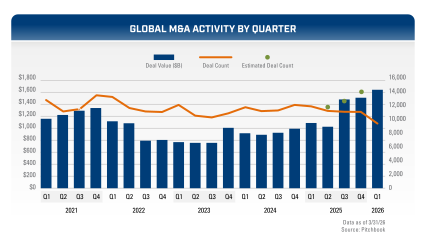 Global M&A activity accelerated meaningfully in the first quarter. PitchBook data indicates that global deal value reached just under $1.6 trillion, a 50% increase year‑over‑year and a 9% increase quarter‑over‑quarter, supported by momentum that carried over from late 2025. Deal count rose 18% year‑over‑year.
North American activity followed a similar pattern. Deal value exceeded $1 trillion, up 22% quarter‑over‑quarter and 60% year‑over‑year, even as deal count grew more modestly. The market continues to see fewer transactions at higher values, driven in part by large corporate buyers and mega‑cap transactions. Interestingly, one transaction, valued at $250 billion alone represented roughly a quarter of total deal value for the period.
Sector composition has shifted as well. Historically dominant IT activity has moderated amid AI‑related uncertainty, while energy, healthcare, financials, and business services have taken a larger share of deal flow. Many buyers are prioritizing “HALO assets” – capital‑intensive, lower‑obsolescence businesses such as utilities, pipelines, and infrastructure – reflecting a preference for assets perceived as more insulated from rapid technological change.
Valuation multiples remain elevated. Global trailing 12‑month EV/EBITDA multiples held near 10.7x, with North American multiples pushed higher by large corporate and mega‑cap transactions, in some cases reaching 11x to 13x.
Private Equity Navigates Selective Deployment, Longer Holds
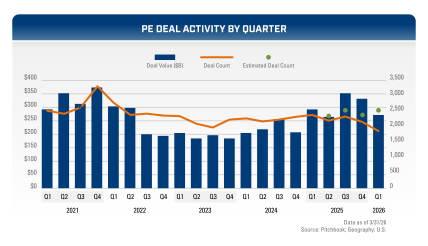 Private equity activity continues to diverge from broader M&A trends. Deal count increased modestly in the first quarter, but deal value declined 18% quarter‑over‑quarter and 7% year‑over‑year, reflecting a shift toward smaller transactions and more selective deployment.
Several themes are shaping the private equity landscape:
- Increased down‑market activity
Larger funds are forming small business investment vehicles to target founder‑owned and first‑institutional‑capital companies. Add‑on acquisitions remain dominant, representing roughly 75% of middle‑market deal activity. - Longer hold periods and evolving exit paths
Many firms continue to hold assets acquired in 2020–2022, with exit counts still 33% below pre‑pandemic levels despite higher aggregate exit values. Continuation funds, partial liquidity solutions, and selective use of the IPO market remain common tools for managing aging portfolios. - Sector‑specific dynamics
Tech‑focused markets continue to see strong private‑market software and SaaS activity, even as public‑market multiples have compressed. Despite this shift in comparables, underlying cash flows and fundamentals for SaaS portfolio companies remain stable, with no significant increase in impairments. Other regions report steady activity in healthcare, environmental services, manufacturing, and business and professional services. - AI as both disruption and opportunity
While AI has pressured public software valuations, private market performance and multiples have remained more stable. Many technology-focused private equity firms view AI as an opportunity to deepen client relationships, particularly where SaaS portfolio companies can leverage proprietary data with vertically integrated or industry-specific software solutions.
Financing Conditions Tighten as Rates, Spreads Remain Elevated
The credit environment remains a defining factor in deal formation and portfolio performance.
Treasury yields and swap rates increased across the curve, with the five-year SOFR swap rates near 3.7%. Higher energy prices and persistent inflation have contributed to a flatter curve and expectations that rates may remain elevated. Leveraged loan and high yield spreads remain wider than at year-end, particularly for lower-rated issuers. CCC-rated first lien STM increased to S+2343 in May from S+1936 at year-end and YTM (3 yr swap) increased to 27.19% from 23.07%.
Private credit spreads are higher than at year end, reflecting market repricing of risk. Borrower performance has been stable despite isolated defaults, and investor attention has increasingly turned to potential AI-driven disruption in certain sectors. Out-of-favor industries, such as software and IT services, are commanding spread premiums over B-Rate averages.
Elevated redemption requests from retail investors have triggered gating in some non-traded interval funds. Institutional allocations to private credit remain resilient, but capital continues to concentrate among large, experienced managers.
Defaults remain modest overall but are concentrated in 2020‑vintage deals underwritten with high leverage and tight interest coverage. Sponsors are becoming more selective in supporting challenged companies, contributing to more restructurings and debt‑for‑equity swaps.
For companies facing tight liquidity or covenant pressures, liability management exercises (LMEs) are increasingly used in debt restructuring negotiations, particularly for distressed companies with covenant-lite debt. Companies and their legal advisors often require valuation advisory services to successfully execute the LME.
Higher spreads and floating rates have increased the overall cost of capital by 50 to 75 basis points, contributing to longer hold periods, amend‑and‑extend activity, and more complex refinancing discussions.
Tax and Regulatory Developments Drive New Valuation Requirements and Considerations
Ongoing legal challenges to U.S. tariff provisions and the slow refund process are contributing to ongoing uncertainty on tax positions. Changes in U.S. and international tax regimes, particularly around the business interest expense, bonus depreciation, pass-through entity (QSBS), R&D expenditure, as well as FDDEI and NCTI provisions, are driving reorganizations and restructurings that have increased the need for tax-related valuations.
Economic pressures, higher interest rates, and tighter liquidity conditions are also contributing to more restructurings, debt exchanges, cancellation of debt income analyses, and related valuation requirements.
The SEC is considering a series of reforms designed to make going public more attractive by lowering execution risk and reducing costs. These initiatives include:
- Allowing all public companies the option to file semiannually rather than quarterly, under a proposed rule.
- Modernizing SEC auditor independence requirements to reflect evolving market dynamics, including the use of AI and private equity investment in public accounting firms, potentially eliminating the need for separate PCAOB independence rules.
- Extending the JOBS Act IPO on-ramp for scaled disclosures and compliance accommodations.
- Revising Form S-3 to eliminate the “baby shelf” limitations, expanding smaller public companies’ access to shelf registration.
The FASB is evaluating an agenda request regarding the continued appropriateness of the NAV practical expedient given the growth in private-market secondary transactions. As part of this review, the FASB will consider whether additional guidance is needed to clarify the role of observable transactions, conditions for applying NAV, and interactions with the ASC 820 fair value hierarchy.
The IFRS Foundation continues to advance a proposal requiring acquirers to disclose the strategic rationale and performance metrics for significant business combinations. If adopted, similar requirements could eventually influence U.S. standard‑setting.
Regulators and standard‑setting bodies, including IOSCO and the IVSC, continue to focus on developing more consistent global valuation frameworks.
Evolving Deal Structuring Trends
Deal structures continue to evolve as buyers and sellers navigate valuation gaps and financing constraints.
- Earnouts remain widely used and increasingly complex, often incorporating multiple performance components.
- Rollover equity and seller notes continue to feature prominently in middle‑market transactions.
- SAFE notes, traditionally used in early‑stage companies, are now appearing in later‑stage, pre‑IPO settings as a liquidity tool ahead of funding rounds or public offerings.
- Carve-outs and restructuring transactions are increasing, particularly where financial sponsors seek to reposition portfolio company assets to improve marketability.
Navigating a Dynamic Mid-Year Landscape
Across markets, the environment remains active but complex. While uncertainty persists – driven by geopolitical events, inflation, and financing conditions – deal pipelines are healthy, valuation activity remains strong, and both corporate and private equity buyers continue to pursue opportunities aligned with their strategic and sector‑specific priorities.
VRC will continue to monitor developments across M&A, private equity, credit markets, tax, and regulatory domains and will provide updates as new information emerges.
For questions on market conditions or valuation considerations, VRC’s professionals are available to help.