
Structured Risk Transfers: Market Growth and Valuation Considerations
Estimated reading time: 3 minutes
The article in brief:
- The use of structured risk transfer (SRT) transactions by banks to manage capital and credit risk has grown substantially in recent years, driven by increased regulatory clarity.
- For private credit funds, SRT transactions can provide risk‑adjusted returns and more efficient capital deployment compared to traditional direct lending strategies.
- Valuing SRT credit‑linked notes is inherently complex, requiring specialized modeling and valuation expertise.
Introduction
This article provides an overview of SRT transactions, examines the growth drivers in the U.S. market, and examines factors contributing to increased adoption by private credit funds. It also outlines unique valuation challenges, highlighting the role of rigorous, specialized valuation approaches in the structural complexity of these instruments.
What is a Structured Risk Transfer?
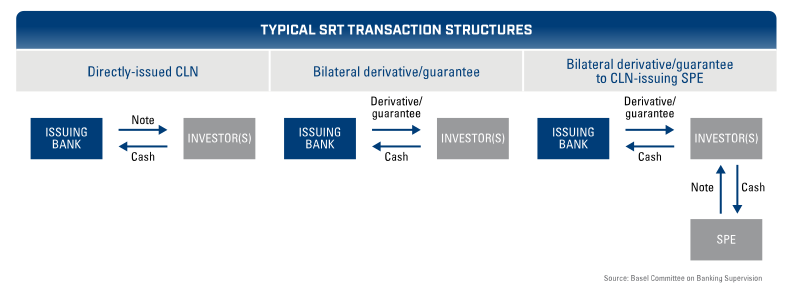
An SRT transaction transfers the credit risk of a pool of assets to a counterparty while the bank retains ownership of the underlying assets. In the U.S., SRT transactions most commonly reference corporate loans, capital call facilities, auto loans, and residential mortgages, with newer asset classes including infrastructure credit and
business development company loans. SRTs can be executed through various structures with differing regulatory capital treatment, including:
- Direct credit-linked notes (CLNs): Notes issued by the bank, where investor proceeds serve as collateral to absorb credit losses on the reference portfolio.
- Special-purpose vehicle (SPV) issued CLN: Notes issued by a bankruptcy-remote SPV, supported by a guarantee or a credit derivative between the issuer and the SPV to isolate and transfer the credit risk.
Regulatory Clarity Accelerates U.S. SRT Market Growth
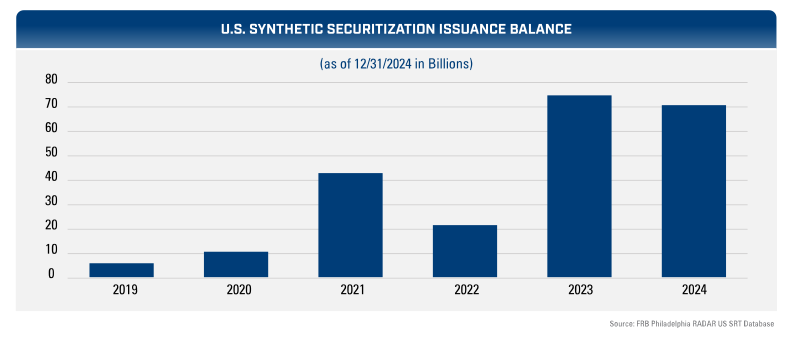
In September 2023, the Federal Reserve published an FAQ confirming that properly structured CLN and synthetic securitization transactions can provide regulatory capital relief for U.S. banks. Before this guidance, such transactions were subject to a lengthy case-by-case approval process. Shortly after, the Office of the Comptroller of the Currency designated these transactions a supervisory priority, prompting banks to develop more robust deal documentation, governance frameworks, and control procedures.
This regulatory clarity spurred the rapid expansion of the U.S. SRT market, encouraging participation by both large and regional banks. The development of repeat-issuer programs, combined with investor demand, further supported issuance scale and greater innovation in U.S. SRT deal structures.
Why Private Credit Funds are Turning to SRTs
SRTs are increasingly being considered alongside traditional loan-by-loan direct-lending strategies in private credit. SRTs provide immediate diversification across hundreds or thousands of borrowers and offer exposure to bank‑originated credit underwritten to conservative standards. Compared to direct lending, SRT may enable more rapid capital deployment and scalability in certain structures by reducing the need for loan origination teams, borrower negotiations, and ongoing covenant management. As a result, private credit funds are the primary investors in SRTs, seeking exposure to a diversified portfolio of bank loans without directly owning the underlying loans and related servicing and maintenance obligations.
Valuation Challenges
Valuing an SRT CLN involves significant complexity due to their structural and data characteristics. SRT tranches are privately negotiated and vary significantly. These instruments embed multiple layers of credit risk, structural features, counterparty risk, and data limitations, all of which complicate modeling and valuation. As a result, valuation of these instruments typically incorporates a combination of robust quantitative modeling and informed qualitative judgment supported by specialized expertise.
- Limited Transparency into Underlying Loan Pools. SRT portfolios often contain granular, sometimes opaque, underlying exposures, making it difficult to model expected losses. Limited loan-level disclosure makes it difficult to estimate expected losses and to calibrate key assumptions, such as the probability of default, loss given default, loss timing, and prepayment assumptions. Reduced transparency can materially increase model uncertainty.
- SRT Structural Complexity. CLNs may be issued directly by banks or through bankruptcy‑remote SPVs and may incorporate guarantees or credit derivative structures. Structural features, including replenishment mechanics, amortization profiles, call options, and tranche design, introduce significant complexity to cash flow modeling and discounting. Differences between SPV‑issued and direct CLNs also affect control over collateral and counterparty exposure. Even minor structural variations can result in large valuation swings, requiring bespoke modeling approaches.
- Counterparty and Credit‑Derivative Pricing Risk. CLNs embed a credit‑derivative component that functions similarly to a tranched credit default swap on a reference loan portfolio. As a result, valuation is sensitive not only to portfolio performance but also to the issuing bank’s credit quality. Changes in issuer credit ratings or CDS spreads, particularly in direct CLN structures, can drive price movements independent of underlying loan performance.
- Tranche‑Based Loss Allocation Challenges. SRT CLNs typically reference mezzanine or junior tranches with nonlinear loss profiles. These tranches exhibit high sensitivity to loss assumptions and generally require simulation‑based valuation techniques. In addition, the use of embedded leverage in the tranche structure can dramatically affect valuation.
- Liquidity Constraints and Market Concentration. The SRT investor base is relatively concentrated, and secondary markets for CLNs are limited, creating illiquidity and rollover risks. As a result, valuations frequently rely on model‑based valuation (Level 3) inputs , consistent with broader private market valuation practices where observable market data is limited.
- Maturity Mismatch Between CLNs and Underlying Assets. When a CLN matures before the underlying loan pool, the maturity mismatch introduces rollover risk, affecting discount rates and valuation volatility, even if the underlying credit fundamentals remain stable.
- Highly Specialized Modeling Requirements. Because SRT CLNs reference bespoke, bank‑specific credit portfolios, valuation may require specialized asset‑based finance expertise. Modeling challenges are further amplified in transactions involving replenishing pools or blind portfolios, where portfolio composition may change over time.
Conclusion
SRT transactions have become an valuable tool for banks to manage capital and credit risk, within a developing market framework characterized by evolving regulatory clarity and increasing investor participation. For private credit funds, SRTs offer access to diversified, bank‑originated credit exposure with the potential for attractive risk‑adjusted returns. However, these benefits come with meaningful valuation challenges driven by limited transparency, structural complexity, tranche‑level loss dynamics, counterparty exposure, and illiquid secondary markets.
Valuation rigor is fundamental to assessing SRT transactions and remains central as the market continues to mature. Accurate valuation of SRT CLNs typically requires specialized modeling, robust assumptions, and a deep understanding of transaction structures and regulatory considerations. Investors and valuation practitioners must carefully assess both quantitative inputs and qualitative risks to ensure valuations appropriately reflect the economic realities of these instruments. Disciplined valuation practices are fundamental to informed investment decision-making, particularly as the SRT market continues to evolve.
How VRC Can Help
At VRC, our Portfolio Valuations practice group has extensive experience valuing complex structured investments. Our team of experienced professionals delivers detailed, well-supported valuations to address the structural complexity and data limitations inherent in these instruments. Valuing more than 30,000 securities annually, we leverage deep technical expertise and a proprietary database of transaction structures, valuation multiples, and key market metrics. This combination of scale, specialized knowledge, and robust data enables us to develop valuation conclusions for complex structured credit investments.
To learn more, contact the article’s authors or any of our valuation professionals.