
Private Company Accounting Elections and IPO Readiness: What Sponsors and CFOs Should Know
Estimated reading time: 3 minutes
The article in brief:
- Private company goodwill accounting elections can simplify reporting but can also create complexity when preparing for an IPO.
- Unwinding these elections can require multi‑year restatements, including reversing goodwill amortization, recalculating purchase accounting, and reassessing impairment triggers.
- Private equity sponsors and portfolio companies should reassess accounting elections well ahead of a liquidity event to avoid delays and added costs.
After years of muted IPO activity and continued reliance on private capital, the Securities and Exchange Commission (SEC) has signaled a renewed commitment to restoring the public markets as a viable, attractive exit for private companies. Even as regulatory friction eases, private equity-backed and privately held companies considering public markets often find that certain accounting decisions made years earlier in a company’s lifecycle can complicate IPO readiness and introduce avoidable timing and execution challenges.
Private Company Council (PCC) accounting alternatives allow private companies to simplify goodwill and intangible asset accounting, but those elections generally must be reversed to comply with public company GAAP when preparing for an IPO.
Why Private Company Accounting Elections Matter for IPOs
PCC accounting alternatives are elected to reduce costs and complexity. These elections are attractive for private-equity-backed businesses during the hold period, as they lower acquisition costs and reduce earnings volatility by replacing potential episodic impairment charges with predictable amortization. For sponsors, these elections are often viewed as a pragmatic choice, especially when the expected exit path is uncertain.
While PCC accounting elections reduce acquisition costs and reporting complexity during the private company phase, they often shift, rather than eliminate, the underlying accounting effort to the point of exit. Even as regulatory reforms make IPOs more appealing, accounting considerations often complicate the path to public markets. With limited exceptions, a company preparing for an IPO must present historical financial statements that fully comply with public company GAAP requirements for all periods presented.
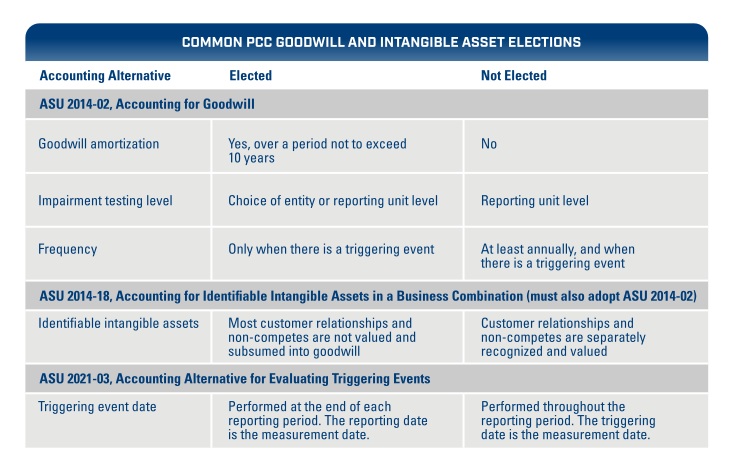
As a result, companies are required to unwind prior PCC accounting elections, accelerate the adoption of accounting standards, and restate historical financials for multiple years. Companies considering a public market listing should reassess PCC accounting elections well before filing to avoid unnecessary disruptions. The included table summarizes the most commonly elected PCC accounting alternatives related to goodwill and identifiable intangible assets and highlights key differences from public company GAAP.
Restatement Challenges When Preparing for an IPO
Challenges arise when a company that has elected PCC accounting alternatives considers an exit or liquidity event, such as going public, issuing public debt, or a sale to a public company. To meet public company GAAP accounting requirements, the company would need to restate its historical financial statements, a process that can include:
- Reversing prior goodwill amortization
- Reperforming purchase price allocations for all acquisitions to measure and recognize intangibles that had been previously subsumed into goodwill
- Recomputing goodwill
- Re-performing annual goodwill impairment tests
- Reassessing goodwill-triggering events during interim periods, without hindsight, at the reporting unit level, which may result in impairment charges.
Depending on the time between the election and the liquidity event, reliable data may be difficult to obtain. As a result, the unwinding process is often more complex and resource-intensive than anticipated, an effort that is frequently underestimated at the outset. These efforts can introduce significant timing, resourcing, and audit considerations at a critical stage of a transaction.
Planning Considerations for Sponsors and CFOs
PCC accounting elections can reduce cost and operational complexity while a company remains private, particularly for acquisitive businesses and private equity–backed portfolio companies. However, as companies pursue a public market exit, those earlier elections may influence both IPO readiness and execution timelines.
Reversing goodwill and intangible asset accounting alternatives frequently requires multi-year restatements, renewed valuation analyses, and renewed impairment evaluations – efforts that can become increasingly challenging as historical data ages.
For private companies considering an IPO or other public market transaction, early reassessment of private company accounting elections can help align reporting efficiency with exit preparedness. Addressing these issues well in advance of a liquidity event allows management teams and sponsors to reduce execution friction and maintain flexibility as capital markets options evolve.
How VRC Can Support IPO Accounting Readiness
VRC supports private equity sponsors and portfolio companies at every stage of the IPO lifecycle, from evaluating accounting elections to executing complex restatements and conducting valuation analyses required for public-company readiness. Contact the article authors or any member of VRC’s professional team to discuss how we can provide valuation analyses and advisory support aligned with public company financial reporting requirements.