
European Private Market Update: Q1 2026
Estimated reading time: 9 minutes
The article in brief:
- European private markets entered a period of price discovery in the first quarter of 2026, with widening dispersion across credit spreads as geopolitical uncertainty, inflation expectations, and sector-specific risks contributed to a more differentiated view of credit quality and performance.
- Direct lending activity remained supported by substantial available capital, with lenders deploying selectively and applying greater scrutiny to lower-quality, cyclical, and AI-exposed businesses.
- Deal activity and fundraising slowed, while refinancing activity and alternative liquidity solutions continued to support portfolios, with a gradual improvement in activity dependent on stabilization in broader market conditions.
Pricing Trends
Public credit and equity markets weakened in the first quarter of 2026 amid heightened inflation concerns and increased geopolitical uncertainty related to the ongoing conflict in the Middle East. Market participants also continued to assess implications of AI’s potential impacts for certain software-focused business models.
According to Pitchbook, secondary credit spreads for B-rated European secondary loans widened by approximately 65 basis points relative to year-end 2025. Over the same period the MSCI Europe Small Cap and Mid Cap Indices declined by approximately 5% and 2%, respectively, year to date. While broader indices showed greater stability, certain subindices showed significantly more widening. Credit spreads within European IT services and software industries widened by more than 200 basis points compared to year end levels.
VRC’s proprietary research indicates European direct lending unitranche pricing during the first quarter of 2026 were as follows, inclusive of coupon margin and original issue discount benefits:
Unitranche Loan Credit Spreads, considering Coupon Margin and OID Benefit
- Traditional Middle Market (≤ ~€75mm EBITDA):
- Issuance Price : ~97.5 – 98.5; Coupon Margin: ~5.00% – 6.00%
- Credit Spread: ~5.25% – 6.25%
- Upper Middle Market (˃ ~€75mm EBITDA):
- Issuance Price: ~97.5 – 98.5; Coupon Margin: ~4.75% – 5.75%
- Credit Spread: ~5.00% – 6.00%
While in price discovery, direct lending pricing remained broadly consistent with levels observed in the fourth quarter of 2025, despite public market volatility. European direct lenders continue to hold substantial dry powder, while new issuance remains limited and lender demand is high, keeping terms competitive for regular-way credits. However, transactions involving more storied, lower-quality credits, or AI exposure will likely carry pricing premiums, which are estimated at 50 to 100 basis points since December, if they are brought to market at all, which reflects elevated uncertainty and risk that varies by industry and geography. As a result, dispersion across VRC’s matrix bands is wider and more concentrated around the midpoint of each range, whereas during the fourth quarter of 2025, observed transactions were more clustered toward the lower to middle points of the ranges, reflecting more pronounced competitive pressures.
Relative to the U.S. direct lending market, European unitranche credit spreads exhibited less widening during the period, compared with an increase of 25 basis points in the U.S. since year end 2025. Market participants observed that European credit spreads tightened modestly early in 2026, while comparable U.S. credit spreads remained relatively stable. As a result, comparisons to year-end 2025 levels may be partially obscuring an underlying widening trend with the European markets. In addition, European credit markets have more limited exposure to retail investors, who have been redeeming U.S. funds and reducing available dry powder in the U.S. system.
Since December 2025, yields based on spot EURIBOR and SONIA reference rates have widened by approximately 5 and 10 basis points, respectively. Five-year swap-based yields have risen nearly 30 bps for EURIBOR-based loans and approximately 50 basis points for SONIA-based loans. Market interest rate expectations have shifted higher since year-end, reflecting the possibility that central banks may be required to raise interest rates to address inflationary pressures associated with the Middle East conflict and resulting higher oil prices. If such conditions persist, the all-in cost of debt could increase, placing additional pressure on interest coverage ratios for existing loan deals. Forward curves, however, have been volatile, responding to ongoing, real-time changes in market expectations regarding the duration and severity of the oil price disruption.
Despite broader market volatility, purchase multiples for higher-quality companies are expected to remain relatively elevated, with credit spreads generally tight and underwriting standards aggressive. This dynamic will likely persist until new deal activity increases, helping offset the substantial dry powder among private equity sponsors and direct lending platforms. By contrast, cyclical, storied, and AI-exposed companies and industries continue to require materially higher risk premiums, contributing to increased dispersion across valuations and financing terms.
Deal Volume Trends
European direct lending deal volumes declined on a quarter-over-quarter basis during the first quarter of 2026 to €8.3 billion compared with €12.4 billion in the prior quarter, according to Pitchbook Leveraged Commentary and Data. Concerns related to AI exposure and the ongoing Middle East conflict materially weighed on activity, as market participants reassessed the creditworthiness and forward outlooks of existing portfolio holdings and prospective investments.
As a result, M&A volumes have remained subdued amid ongoing valuation mismatches between buyers and sellers. However, M&A activity improved during the latter half of 2025 relative to 2024 levels, and refinancings and add-on acquisitions for existing portfolio companies dominated direct lending activity in the early part of the first quarter of 2026. Lenders also remained willing to provide follow-on capital to support buy-and-build strategies and other accretive investments.
Year‑to‑date in 2026, European private equity fundraising declined on a year‑over‑year basis to €18.0 billion, from €23.7 billion in the prior‑year period, extending the fundraising slowdown observed in 2025, when totals fell to €80.8 billion from €146.7 billion, according to Pitchbook. The decline has been driven in part by a challenging exit environment for legacy investments. In response, private equity sponsors have increasingly explored alternative liquidity options, including dividend recapitalizations, NAV financings, minority sales, and continuation vehicles. Direct lenders have generally remained willing to fund these structures, though underwriting has been more cautious given elevated risk profiles and potential conflicts of interest.
Against this backdrop, and amid an ongoing period of price discovery, the outlook for M&A activity and alternative exit pathways for private equity investments has become more uncertain. Direct lenders report greater scrutiny during due diligence processes, although deal pipelines remained active during the first quarter of 2026 and lenders continue to deploy capital selectively. Should geopolitical tensions in the Middle East ease and oil prices stabilize, several factors could support renewed positive momentum in M&A activity and alternative exit routes, including increasing pressure on private equity sponsors to return capital following extended hold periods, approaching loan maturities, substantial available dry powder, and an all‑in cost of debt that remains below 2024 levels. Together, these dynamics may contribute to a gradual improvement in activity during 2026.
Portfolio Company Performance
Direct lenders generally expect portfolio performance to remain stable, although higher oil prices and the potential for renewed inflationary pressure continue to pose material risks. While AI exposure is also cited as a risk consideration, many lenders note that it has been a material consideration in underwriting frameworks for some time. As a result, recent lending activity has largely focused on businesses with limited exposure, durable competitive positions, or offsetting attributes such as significant regulatory or compliance requirements, proprietary data assets, or meaningful customer interaction. European borrowers may continue to exhibit relative advantages compared with their UK counterparts, reflecting divergence in the historical rate‑cutting cycles of the ECB and the BOE, which has contributed to lower all‑in yields for EURIBOR‑denominated loans.
Although idiosyncratic challenges persist, default rates remain modest. According to Pitchbook Leveraged Commentary and Data, S&P Global Ratings projected in November 2025 that the European speculative‑grade default rate would decline to 3.25% by September 2026, from 3.7% in September 2025. However, a March 2026 survey conducted by the International Association of Credit Portfolio Managers highlighted increasing default risk perceptions tied to higher oil prices.
While the majority of credits continue to perform, certain portfolio companies have begun to exhibit signs of stress. These situations are primarily concentrated among issuers with pre‑existing challenges, particularly those originating from 2021 to 2022 post‑pandemic vintages, which tend to carry higher debt loads than the current interest‑rate environment comfortably supports. Sponsors and direct lenders have addressed these cases through common capital structure solutions, including payment‑in‑kind (PIK) toggle adjustments, maturity extensions, sponsor equity infusions, enhanced liquidity monitoring, and covenant amendments. Such measures are intended to mitigate elevated debt costs by reducing leverage and cash interest obligations. In exchange, direct lenders typically receive additional economic considerations—such as PIK premiums, amendment fees, or principal repayments—along with enhanced control features, including tighter covenants, expanded reporting requirements, and transaction milestones. This constructive approach has helped limit defaults and realized losses to date, although some situations have resulted in defaults, most commonly through debt‑for‑equity swaps or liability management exercises. Adverse outcomes could become more prevalent if market conditions remain less supportive for storied, stressed, or AI‑exposed companies.
Conclusion
Private markets remain competitive, with higher-quality companies continuing to attract strong valuations and aggressive financing terms, consistent with last quarter. However, the European direct lending market has entered a period of price discovery as participants assess the potential effects of higher oil prices, inflation risk, and evolving AI-related disruption. As a result, dispersion across observed financing terms has increased, and the outlook for a near-term rebound in M&A has become less certain.
Portfolios continue to include challenged companies characterized by elevated leverage, constrained interest coverage, and near-term maturities, particularly among pre-2022 vintages. Heightened uncertainty may further pressure these companies and constrain exit opportunities, increasing the likelihood that restructuring or other capital structure solutions will be required, which could weigh negatively on valuations.
As always, valuation analyses should be conducted on a case-by-case basis, emphasizing core performance metrics, debt sustainability, and liquidity. Performance is likely to remain uneven, with certain credits continuing to outperform others in the current environment.
VRC European Market Credit Spread Matrix
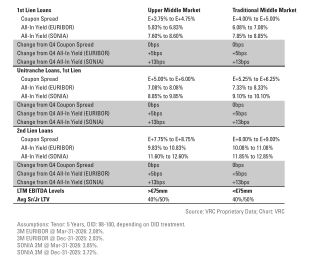 During the first quarter of 2026, VRC held credit spreads for the middle market matrix unchanged from the fourth quarter of 2025.
- Heightened geopolitical tensions in the Middle East contributed to slower European loan issuance during the first quarter.
- European private lenders continue to hold substantial dry powder that will need to be deployed, which has supported competitive direct lending terms despite recent market volatility.
Quarterly GDP Growth
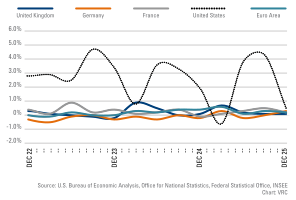 During the third quarter of 2025, US GDP growth of 4.3% year-over-year remained well above growth rates observed in the Euro area and the UK. Growth in the U.S. GDP slowed materially in the fourth quarter of 2025 declining to 0.50%.
- In the U.S., GDP forecasts have generally trended lower amid increased market volatility and geopolitical uncertainty related to the Middle East. the conflict in the Middle East. The Atlanta Fed’s GDPNow model currently forecasts first quarter 2026 U.S. GDP growth at approximately 1.2%.
- GDP growth in the Euro area has remained positive but modest, with 2026 forecasts ranging from 1.1% and 1.3%. Spain, Portugal, and Greece continue to outperform regional averages, although the overall Euro area growth forecast is tempered by slower economic activity in the UK and France.
- Weaker external demand for goods and tariffs imposed by the U.S. have weighed on GDP growth across several European economies, particularly Germany. Increased household and government consumption has partially offset weaker German export demand, contributing to a return to positive growth in Germany during the second half of 2025.
Inflation Rate
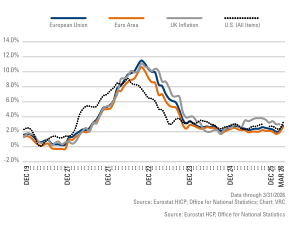 Inflation in the United Kingdom decreased to 3.0% in February, from 3.4% in December, although remains elevated due to still high inflation in the education (+5.1%) and housing (+4.6%) sectors.
- Inflation in the European Union rose to 2.8% in March, from 2.3% in December.
- Inflation for the Euro Area increased to 2.6% in March, from 2.0% in December.
- Inflation in Euro Area remains lower than in the U.S., which allowed the ECB to cut rates earlier in June 2025 to 2.00%.
- The Bank of England cut its Bank Rate by 25 basis points in the December 2025 meeting, bringing the rate to 3.75%. This is still at a premium over Europe partly due to the higher overall inflation in the UK.
- In the U.S., the Fed cut rates by 25 basis points in its December 2025 meeting, bringing the Fed Funds target rate to 350-375. Market participants are currently forecasting a slower pace of rate cuts in 2026, with most expecting 0-2 additional 25 basis point rate cuts by December 2026, per CME FedWatch, representing a slower pace of rate action than economists were forecasting in the fourth quarter of 2025.
Reference Rates
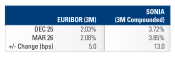
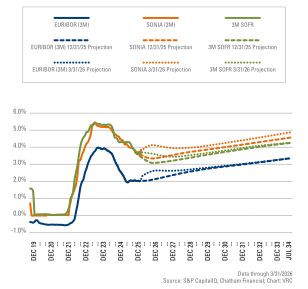 3M EURIBOR increased to 2.08% in March, from 2.03% in December, and 3M SONIA increased to 3.85% in March, from 3.72% in December.
- Currently, the ECB is not expected to make any near-term movements. According to Chatham Financial forecasts, EURIBOR rates are projected to rise in early 2026, and increase to the ~2.75%-3.25% area long-term. SONIA is projected to rise to 4.0% in the near term and continue to increase towards 4.75% long-term.
- After easing rates in 2025, the outlook has shifted to holding rates steady or potentially increasing rates in 2026 as central banks are increasingly cautious around stubborn inflation and recession risks.
Secondary Spread-to-Maturity and Yield-to-Maturity
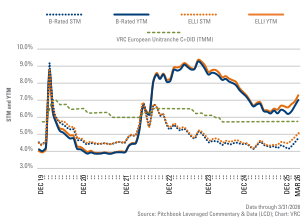 Spread to maturity for the ELLI Index increased to E+504 in March, from E+450 in December. Meanwhile, the ELLI Index YTM increased to 7.30% in March, from 6.58% in December.
- The European B-rated loan spread to maturity rose to E+479 in March, from E+415 in December. Yield to maturity for B-rated loans moved higher to 7.01% in March, from 6.20% in December.
- Volatile market conditions in BSL markets coupled with relatively stable private debt spreads imply the illiquidity premium between the two markets has compressed in the first quarter of 2026.
Leveraged Loan and High-Yield Bond Volumes (€Bn)
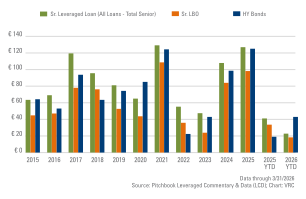 Senior loan issuance remained strong in 2025, with €03 billion issued in 2025 – surpassing 2024’s full-year total and increased 17.7% year-over-year. Thus far in 2026, €22.70 billion of senior loans have been issued versus €41.12 billion issued in the same period last year, a 44.8% decrease.
- 2026 began with strong issuance and active markets, although given conflict in the Middle East and negative headlines surrounding private markets, issuance has slowed in the latter half of the first quarter of 2026.
Broadly Syndicated Credit Statistics (Primary)
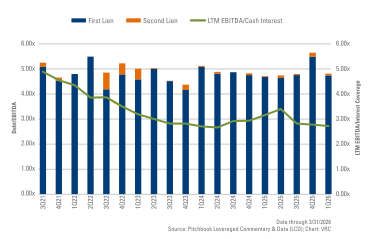 In 2025, average leverage ratios for the syndicated lending market increased above 5x for the first time since the first quarter of 2024.
- In 2026, leverage ratios continue to remain in the ~5x area. Meanwhile, average interest coverage declined to 2.71x in the first quarter and remains below the ~4.0x historical average pre-2022.
European Speculative-Grade Default Rate
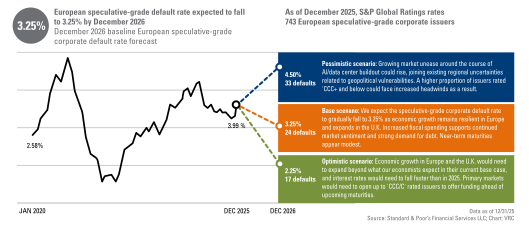 According to S&P, European speculative-grade corporate defaults will decrease to 3.25% by December 2026 in their most recent base-case forecast. We note this is nearly 50 basis points lower than the expected default rate for the U.S.
- Overall, these levels are still relatively low compared to other higher stressed periods (Great Recession, COVID, etc.) and are unlikely to lead to material portfolio losses for managers and investors.
- A recent survey conducted by the International Association of Credit Portfolio Managers notes increasing default risk due to the recent rise in oil prices.
European Private Equity Deal Activity
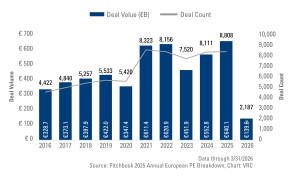 2025 was a record year for European private equity deal activity, with €640.1 billion, a nearly 15.8% increase compared to 2024 totals (€552.8 billion), as reported by Pitchbook. Activity began to pick up materially in late summer, with €352.9 billion volumes in the second half of the year.
- Thus far in 2026, €139.6 billion private equity deal activity has been recorded, run-rating for €558.55 billion, which would represent an approximate 12.7% decline versus record 2025 figures.
- In 2026, LBO volumes increased, currently accounting for 58.6% of deal volumes, slightly higher than 57.2% in 2025.
European Private Equity Fundraising
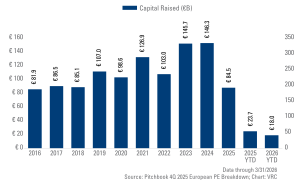 2025 proved to be a difficult year for private equity fundraising in Europe. According to Pitchbook, European private equity funds raised only €84.5 billion in 2025, an approximate 42.3% decline compared to 2024’s record figure of $146.3 billion. Thus far in 2026, only €18.0 billion has been raised.
- Year-to-date 2026 fundraising is about 24.1% lower than the same period last year. The fundraising environment could continue to be constrained due to the challenging exit environment for historical investments.
European Dry Powder (€M)
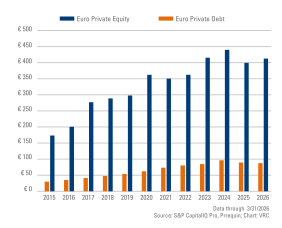 According to data from CapitalIQ Pro, cumulative dry powder in 2025 for private equity sponsors in Europe is €412.6 billion, which should fuel deal flow in for the remainder of the year without additional fundraising needs. European private debt currently has about €87.6 billion dry powder.
- These figures also support the continued high demand for private credit. Assuming an average 50% LTV on private equity deals, the dry powder figures imply that there is an equal demand of ~€412.6 billion for credit to finance private equity leveraged buyouts.
Median European EV/EBITDA Buyout Multiples
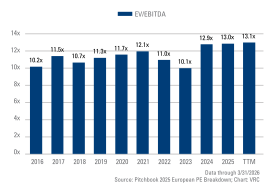 European median private equity buyout EV/EBITDA multiples increased to 13.1x in the first quarter of 2026. EV/EBITDA multiples have been steadily increasing from 2024 onward, and first quarter 2026’s figure of 13.1x is a new record.