
1Q 2026 Update: Middle Market Credit Spreads, Required Returns
Price discovery emerges as AI and geopolitical volatility cloud the inflation and rate outlook
Estimated reading time: 2 minutes
The article in brief:
- Heightened volatility in early 2026, driven by AI-related disruption concerns and geopolitical developments, pushed credit markets back into price discovery mode.
- Primary market activity slowed late in the quarter, while secondary spreads widened, particularly for technology and software-exposed credits.
- Despite near-term uncertainty, lender demand remains strong, and the market backdrop continues to favor high-quality borrowers, with higher risk premiums for AI-, tariff-, and cycle-exposed assets.
In the first quarter of 2026, private debt markets have entered a renewed phase of price discovery, navigating a more challenging and volatile backdrop, shaped by several notable developments:
- A sharp selloff in software and technology services in loan, bond, and equity markets, driven by concerns that new AI tools could disrupt existing business models
- Significant investor redemptions from private funds following reports of hidden losses and valuation issues tied to technology assets
- A renewed conflict in the Middle East involving Iran, the U.S., and Israel, which increased global macro risk and added upside pressure to inflation, particularly through the oil industry.
Collectively, these factors slowed M&A activity and increased capital market volatility. The geopolitical situation in the Middle East contributed to volatility in oil and oil-based products, increasing upside risks to the inflation outlook and complicating the Federal Reserve’s policy path for the remainder of 2026.
Elevated volatility late in the first quarter effectively stalled primary lending markets. Transactions already in process continued to close, generally without terms being re-traded. In secondary markets, average B-rated loan spreads remain about 67 basis points wider than year-end levels. Performance has been weaker in software, where spreads widened by approximately 200 basis points since year-end. Under current risk-off conditions tied to AI-related uncertainty, lenders expect most software issuers to price at an additional premium of roughly 75 basis points. Borrowers with unresolved AI-related risks remain largely shut out of the market until those risks are fully vetted.
As a result, VRC increased credit spread ranges across all credit instruments by 25 basis points in our March 2026 pricing matrix:
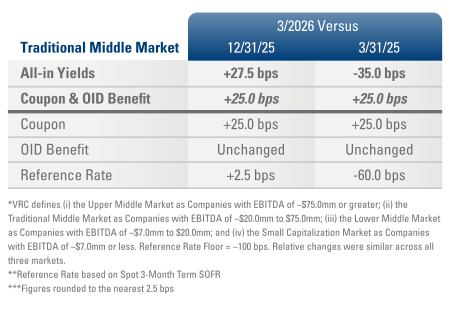
Technology and software services loans continue to price at wider-than-average premiums given risk-off conditions and lower implied enterprise values, which have driven higher loan-to-value ratios quarter-over-quarter. As a result, lenders continue to evaluate AI-impacted borrowers on a case-by-case basis.
Outlook
Higher-for-longer rates continue to weigh on M&A activity. By March 2026, deal volumes were 42.4% lower than January levels, following a modest reopening in the second half of 2025 and early 2026. A more challenging exit environment and extended hold periods are likely to persist in the near term. That said, substantial dry powder remains available, and a stabilization in AI-related concerns or geopolitical tensions in the Middle East could allow markets to reopen quickly.
While uncertainty persists, the current deal environment remains favorable for high-quality assets. Elevated purchase multiples, tight credit spreads, and aggressive underwriting are expected to continue. However, companies exposed to tariffs, AI, or cyclical trends will likely face higher risk premiums.
Portfolio Performance and Credit Risk
Direct lenders expect portfolio performance to remain stable, although higher oil prices and the potential for higher inflation pose material risks. While AI is also considered a risk, many direct lenders note that it has been a material consideration in underwriting for some time and, as a result, loans have largely been to companies with low exposure, strong moats, or potential benefits (significant regulatory or compliance component, proprietary data, material customer interaction, etc.).
While most credits are performing, some portfolio companies are showing signs of stress. Workouts primarily impact companies with known issues, especially 2021-2022 post-COVID vintages that carry higher debt loads than today’s interest rate environment supports. These situations may require restructuring or other capital structure solutions, which could weigh on valuations. Adverse outcomes may become more common if the market remains less receptive to storied, stressed, or AI-exposed companies.
As always, valuation analyses must be approached on a case-by-case basis, emphasizing core performance metrics, debt sustainability, and liquidity. Some credits will continue to outperform others, reflecting the uneven nature of the current environment.
How VRC Can Help
VRC’s Portfolio Valuation Services practice group provides independent fair value measurements across private credit, structured instruments, and complex securities, helping sponsors maintain consistent valuation practices and defensible documentation as market conditions evolve. For questions on market conditions or valuation considerations we welcome you to contact the article author Adrian Lowery or another VRC professional.