
Recalibrating Value: Digital Infrastructure Transformation
Estimated reading time: 4 minutes
The article in brief:
- The AI revolution and the buildout of the supporting digital infrastructure are driving an unprecedented demand for capital.
- Innovative financing models are attracting a broader pool of investors.
- Valuation methods are evolving to accommodate the complexity of digital infrastructure investments, blending corporate, project, and structured finance approaches.
Introduction
The scale of capital needed to finance digital infrastructure—computing power, high-speed data transmission, and scalable storage—has accelerated sharply alongside the growth of artificial intelligence (AI). This expansion is reshaping debt and equity markets and drawing in a wider investor base. Dealmakers and lenders are recalibrating how they assess value, structure transactions, and manage long-term risk, creating both new opportunities and valuation challenges.
Sector Fundamentals and Growth
The growth in digital infrastructure, particularly in data centers, fiber networks, and wireless technologies, is fueling an extraordinary surge in capital demand across both debt and equity markets. Robust development pipelines, large-scale projects, and active M&A activity reflect a thriving landscape for lenders.
Individual deal values are reaching record-breaking levels, with one landmark transaction in October 2025 valued at $40 billion. McKinsey reports that private infrastructure assets under management have tripled from approximately $500 billion in 2016 to $1.5 trillion in 2024. Notably, in the first half of 2025, digital infrastructure accounted for 25% of all capital raised across sector-specific investments.
Data Center Financing Evolution
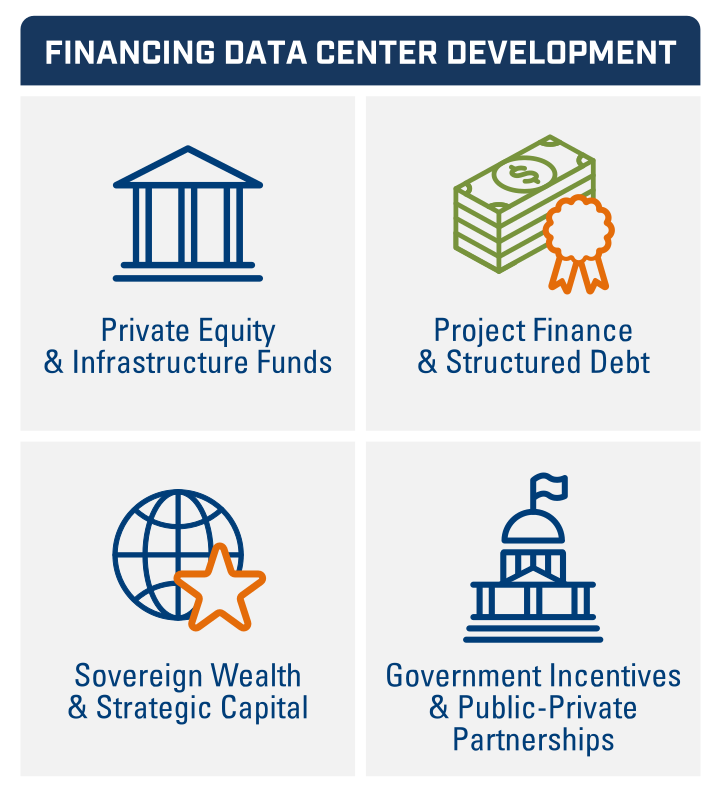 Data centers have evolved from a niche real estate segment to a sought-after core asset class. The data center financing lifecycle has also expanded beyond traditional real estate lending. Depending on the project’s scale, funding can come from a diverse range of sources, including senior and mezzanine debt from financial institutions, debt capital market issuances, asset financing arrangements, and equity investments.
Private equity firms are increasingly employing innovative strategies such as sponsor-to-sponsor transactions, minority stake sales, and partnerships with sovereign wealth funds to finance larger projects. For smaller-scale projects, financial institutions are turning to club deals, in which multiple lenders share exposure when loan sizes are too large for a single institution but too small to warrant full syndication.
Traditionally, private placements carried a 10-year maturity, but a recent data center deal had a five-year tenor to better match technology refresh cycles and mitigate lease-renewal risk.
Securitization and Credit Enhancement
Private equity firms and lenders are holding $20 billion in maturing pandemic-era construction loans that will need refinancing. Data center debt is well-suited for securitization due to the long-term leases with credit-worthy tenants, which provide stable cash flows.
While asset-backed securities (ABS) transactions currently lead in terms of volume, commercial mortgage-backed security (CMBS) structures are gaining traction—particularly for single-asset, single-borrower transactions. In September 2025, the first data center ABS master trust structure was issued, adapting a framework traditionally used for credit card and student loan receivables. The master trust model helps reduce legal and administrative expenses while offering customized debt tranches with varying maturities and risk profiles to meet diverse investor preferences.
To enhance the credit profile of data center assets, an innovative insurer is now offering Service Level Agreement (SLA) insurance designed to shield investors and operators from financial losses arising from SLA violations, such as downtime or latency disruptions.
Institutional investors are commonly limited, due to regulatory and risk management requirements, to purchasing investment-grade securities. To expand institutional access, data center securitizations are increasingly being rated. Moody’s and S&P have both revised their rating methodologies for ABS and CMBS transactions involving data centers, though they take distinct approaches: Moody’s uses its Structured Finance Rating Methodology, while S&P applies its Project Finance Methodology. Rated securitizations have attracted substantial investment by pension funds, insurance companies, and infrastructure-focused investment vehicles.
ABS and CMBS will continue to play an essential role in the growth of the data center sector, along with project finance, private credit, and the corporate debt market. Data center ABS is the fastest-growing segment of the ABS market, with $35 billion in outstanding volume. As of late 2025, about $13.4 billion of data center ABS across 17 shelves, with another $7.0 billion in CMBS.
GPU-as-a-Service and Emerging Models
The growth of generative AI and large language models has driven massive demand for graphics processing units (GPUs) and led to the emergence of new market participants offering GPU-as-a-Service. This model enables users to rent GPU access on demand, eliminating the need to purchase and maintain their own hardware.
Providers host GPU clusters in data centers and offer flexible commercial models—charging by the hour, per second, per job, or through fixed-term contracts ranging from one to three years. Financing these projects presents additional challenges, including demand and GPU cost uncertainty, shorter lease durations, hardware obsolescence, and credit risk stemming from a diverse customer base.
Valuation Trends
Valuing complex, evolving digital transformation debt and equity investments has become more complicated. New capital from private equity, sovereign wealth funds, and infrastructure investors has driven up valuations and compressed capitalization rates. Recent private capital deals have loan-to-value ratios of 60% to 75%, and in some cases up to 90%, depending on the facility type and market.
Valuation models must now incorporate new data benchmarks such as IT load and power availability. Multidimensional models must integrate criteria across traditional valuation methods:
- Corporate Finance: For large operators with diversified portfolios and strong balance sheets, valuations consider long-term tenant stability, contractual reliability (take-or-pay terms), cash flow predictability, and credit quality.
- Project Finance: Used when evaluating standalone developments with construction and operational risks. Evaluations include construction risk (timeline, budget, contractor strength), operational risk (uptime guarantees, redundancy, cooling/power infrastructure) and market risk (demand for capacity, competitive landscape).
- Structured Finance (ABS/CMBS): Applied to securitized deals backed by lease payments.
Despite recent innovations in this sector, the primary focus remains on creditworthiness. Long-term, investment-grade tenants (hyperscalers), stable cash flows, and contractual reliability are the most critical elements for securing favorable financing terms. VRC is seeing deals where the debt and leverage are underwritten to a specific debt service coverage ratio (DSCR) of generally 1.35 to 1.45 over the expected lease term.
Conclusion
The rapid expansion of AI has transformed digital infrastructure from a niche asset class into a driving force in global capital markets growth. As data centers, fiber networks, and GPU-as-a-Service models proliferate, financing strategies and valuation methodologies will continue to evolve. Investors and lenders must navigate a complex matrix of deal structures, credit metrics, and capital sources to determine value and manage risk. Success in this dynamic sector hinges on rigorous valuation practices and a clear understanding of risk fundamentals.
How VRC Can Help
Investors must navigate a complex matrix of deal structures, credit metrics, and capital sources to determine value and manage risk.
VRC has extensive experience valuing digital infrastructure assets, including data centers, fiber networks, and structured finance vehicles supporting these investments. Our clients rely on our valuation services to support their internal valuations, answer questions from their auditors, and provide comfort to their investors.
To discuss your digital infrastructure valuation needs, we invite you contact the article author, Christopher Walling, or any VRC professional nearest you.

