
Private Credit’s Ability to Withstand Economic Pressures
Estimated reading time: 6 minutes
The article in brief:
- The private credit market has withstood significant economic pressures, including a sharp increase in interest rates, without experiencing a widespread wave of defaults.
- The market’s resilience can be attributed to various factors, including the ability of lenders to restructure loans and the capacity of borrowers to absorb higher interest costs.
- An examination of the current market conditions and trends reveals that private credit defaults remain modestly above historical levels, but are not yet at crisis levels, suggesting a more stable outlook for investors.
The private credit industry once again has been finding itself under close scrutiny. With the incredible growth of the asset class in recent years, questions have arisen as to whether private credit poses a potential systemic risk to the financial system, since the market has not yet been tested by a significantly prolonged period of stress. While the brief but sharp market upheaval in early 2020 during the pandemic did serve as a meaningful test, it was short-lived compared with the type of sustained stress that some observers remain concerned about.
As a leading valuation provider for private credit managers, banks, and investors, with more than two decades of experience in the private debt market, our experience indicates that private credit funds have and continues to face testing through a range of market conditions and, to date, have generally demonstrated resilience.
Assessing the Middle Market’s Resilience
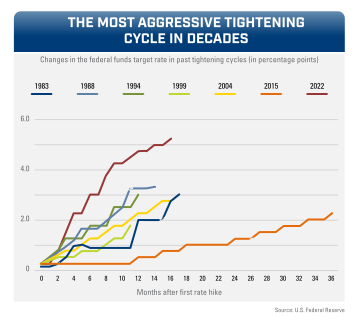 Beginning in March 2022, the Federal Reserve embarked on an aggressive tightening cycle, raising the fed funds target rate by 525 basis points in just 16 months. Three-month SOFR, the most common base rate benchmark for middle-market loans, saw a similar increase.
Meanwhile, in 2021 through the middle of 2022, the private equity and private credit community engaged in record deal activity that was characterized by high purchase price multiples and record leverage levels to finance such deals. The deals were generally underwritten assuming a 1% “floor” SOFR rate, which was generally expected to remain at that level or slightly above throughout the life of the loans.
Consequently, after the Fed increased rates over 500bps and SOFR followed accordingly, borrower interest costs expanded, leading to tightened coverage ratios and reduced liquidity. Interest costs increased by more than 50% across the board for floating rate borrowers, and interest coverage ratios declined to ~1x, where cash flow was covering interest payments. Moreover, the Fed’s ongoing policy stance of “higher for longer” given stubbornly high inflation with steady macroeconomic growth emerged as the primary monetary policy stance. Financial market observers warned of the prospect for a wave of defaults as leveraged borrowers reckoned with higher base rates on older vintage floating rate loans and an inability to refinance loans given high leverage ratios and an uncertain outlook, given that the economy showed signs of slowing, notably through the summer of 2025.
In response to the slowing economy, recession risk, and a material rise in default rates, the Fed lowered the Federal Funds Rate by 100bps between September and December 2024, providing some relief to borrowers with high amounts of floating rate debt. However, this rate cut was only one factor that contributed to improved conditions for overleveraged borrowers. The tightening of credit spreads also played a significant role, as many borrowers were able to refinance their debt at lower rates, which in turn helped to stabilize coverage levels. Despite these developments, the Fed’s subsequent pause on rate reductions and the introduction of new trade tariffs led to ongoing uncertainty. Many outsiders continued to believe that a large wave of defaults and credit losses was still imminent, which, combined with concerns about the macroeconomic outlook, potentially affected the recovery prospects for higher-levered private credit borrowers.
Default Rates and Lender Protections
So far, default activity in private credit markets has remained relatively contained. The KBRA DLD Direct Lending Index1 showed a trailing 12-month default rate of 1.8% as of September 11, mirroring the 1.8% rate reported at the end of 2024—which remains materially below thresholds that would generally raise systemic concerns. Moreover, KBRA’s latest forecast suggests a potential uptick in defaults, with the lower middle market default rate expected to reach 3% by year-end, driven by a growing pipeline of stressed borrowers. This forecast is notable, as it reverses the previous trend and exceeds the projected overall U.S. direct lending default rate.
By contrast, high-yield public markets typically exhibit higher default expectations. While Moody’s cites2 default rates of 3 to 4% (and credit losses at around 3.2%), actual observed defaults in high-yield indices are closer to 2.5%, averaging around 1.7%, and suggesting that current spreads embed a healthy buffer of 0.9% to 1.5% above loss expectations.
However, recent broader data tells a more mixed story. S&P reports3 a trailing 12-month high-yield default rate above 4% through September 2025, near long-term averages (~4.5%), and a forecasts the rate falling to 4.25% by June 2026. UBS forecasts 2025 defaults of ~4.8% (USD HY) and ~3.3% (EUR HY), although those fall to about 1.2% when excluding a few distressed outliers. Deutsche Bank also suggests that defaults may fall to ~4.4% by the end of 2025, before climbing to 4.8% to 5.5% in 2026.
It is also important to distinguish between reported defaults – typically outright missed payments – and broader adjusted measures of default risk that more closely reflect the realities of private markets. Because private loans are often held by a small group of lenders (sometimes just one), lenders and sponsors are frequently able to restructure or amend terms via various liability management exercises (LMEs) before a missed payment occurs. LMEs often include the following or a combination of the following: debt-for-equity exchanges, covenant waivers, maturity extensions, amendments, equity infusions, and PIK toggles.
While these actions help preserve value and buy time for borrowers, they are effectively signs of stress and a more complete measure of risk to capture. It’s also relevant to point out that these LMEs are a way for lenders to extract additional economics and protections to partially offset the incremental risk borne when there are quasi-default events.
According to the latest Pitchbook LCD Distressed Weekly report4, as of August 31, 2025, the trailing 12-month default rate for conventional payment defaults in the U.S. leveraged loan market stood at 1.36%, with 15 issuers defaulting across 1,244 facilities. The combined rate, including distressed LMEs, is significantly higher at 4.37% as tracked by issuer count. For context, this combined rate is below the recent high of 4.70% reported in December 2024, suggesting a potential stabilization in distressed activity.
Another important distinction is in lender protections. Private credit loans often carry tighter financial covenants, including maintenance provisions that can trigger earlier lender engagement when performance weakens. High-yield bonds, by contrast, are generally covenant-lite, offering fewer ongoing protections. These structural differences, combined with the prevalence of proactive restructurings in private markets, help explain why default patterns can diverge between the two. While no market is immune to stress, the combination of modest defaults, meaningful covenant protections, and lenders’ ability to act early suggests that private credit remains well positioned to navigate the environment.
Valuation Implications for Private Credit Investors
Valuation is another focus area for private credit investors. VRC has previously highlighted the differences between public and private credit markets, including reporting standards and market volatility. Recent public credit market volatility related to tariff issues highlights the importance of a more measured approach to valuing buy-and-hold securities.
In early April, when the broadly syndicated loan market was trading down sharply on tariff headlines, VRC did widen credit spreads in its proprietary Middle Market valuation matrix for 1st lien, 2nd lien, and unitranche loans by 25 bps from March 2025 levels. Generally, given the excess dry powder in the private markets relative to new LBO/M&A-led issuance demand, competition kept new issuance terms, albeit at lower volumes, relatively tight versus first quarter standards and relative to bank secondary trading indications. However, as the tariff concerns eased and public and private markets rebounded, we reverted those valuation matrix assumptions to pre-March levels, even as we applied a more granular credit-by-credit analysis of the tariff impact on individual borrowers. We continue working with clients to apply a detailed analysis of the tariff impacts to their portfolios, in accordance with their established and documented valuation policies. These valuation matrix assumptions are used to support fair value measurement and portfolio valuation analyses and are not pricing quotes or execution guidance.
This approach, which involves applying a uniform spread adjustment in response to breaking news and then conducting a detailed assessment of the impact on individual credits, is well-established. It is similar to the strategy employed by private credit market participants during the pandemic in early 2020, when the global economy was significantly disrupted.
Conclusion
Private equity and private credit markets, given their close and interdependent relationship, have generally worked constructively through periods of stress to minimize losses across both sides. In many cases, this collaboration has resulted in defaults being avoided – or at least deferred- through proactive measures.
The private credit market has thus far demonstrated resilience through rising interest rates, refinancing pressures, pandemics, trade disruptions and other episodic volatility, supported by covenant structures and disciplined valuation practices. At the same time, the market’s continued growth and evolving dynamics mean that risks for borrowers, funds, and investors remain, underscoring the importance of careful monitoring and measured analysis as the sector adapts to future conditions.