
Year-End Reminders: Updating the Incremental Borrowing Rate Under ASC 842
Estimated reading time: 4 minutes.
The article in brief:
- The IBR is not a “set it and forget it” assumption. Regular updates ensure compliance, accuracy, and transparency in financial reporting.
- Changes in market conditions, creditworthiness, or corporate events may warrant an IBR reassessment. Heightened market volatility may necessitate more frequent ad hoc evaluations.
- Review best practices to avoid audit challenges.
As year-end approaches, companies should revisit their discount rate assumptions used under ASC 842, Leases. Auditors and regulators can challenge the use of an outdated Incremental Borrowing Rate (IBR) and the adequacy of supporting documentation for related assumptions and calculations.
Choosing and Reassessing the Right Rate
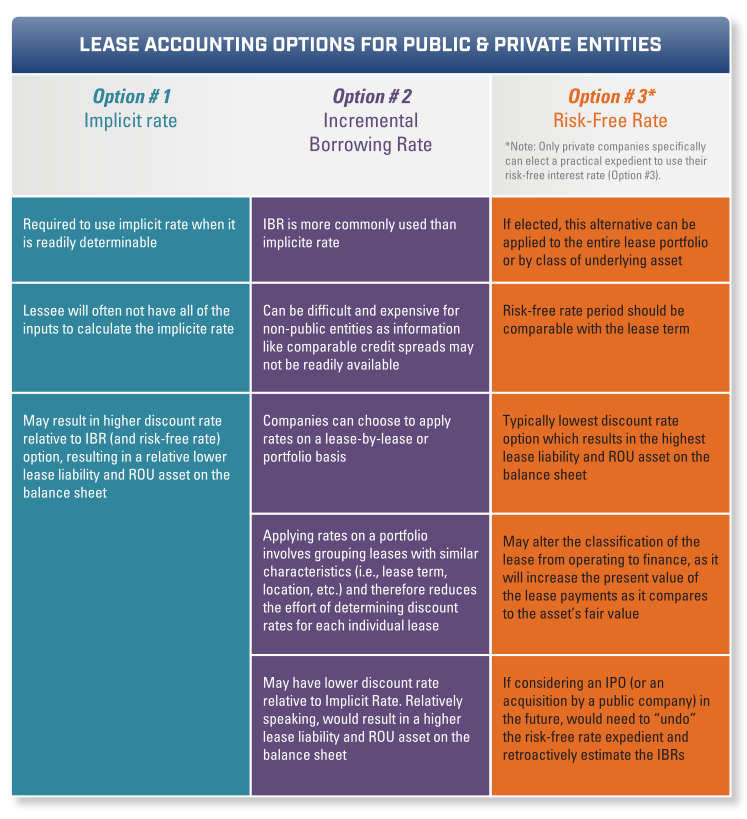 Selecting the discount rate is one of the most critical and complex aspects of measuring lease liabilities. The discount rate is the rate a lessee would pay to borrow a similar amount on a collateralized basis, over a similar term in a similar economic environment. Companies can choose from several options by asset class: the rate implicit in the lease (if determinable), the incremental borrowing rate (most commonly used), or, for private companies, a risk-free rate, which may lead to higher reported liabilities. Refer to the Appendix for additional details.
Both external and company-specific events may trigger a reassessment. If there are significant shifts in market interest rates, credit spreads, or the company’s own creditworthiness, the IBR may no longer reflect a realistic borrowing rate. Similarly, the execution of a merger or acquisition may trigger a need to reassess the rate used for either the target or acquirer.
IBR Under the Microscope
For companies with large lease portfolios, auditors scrutinize the ASC 842 assumptions for reasonableness and consistency and expect detailed support for how the IBR was derived, including methodology, data sources, and rationale for adjustments. Inconsistent or poorly documented approaches are a common audit finding. For multinational entities, auditors look for a defensible, consistent approach across geographies, especially when economic environments differ. Although ASC 842 has been effective for several years, the SEC continues to issue comment letters seeking more details on the basis for using IBR vs an implicit rate and significant judgment and assumptions.
While a company may calculate the IBR internally, partnering with a professional valuation firm can provide a more efficient, supportable approach. Calculating the IBR internally is often time-intensive and requires access to market data, financial modeling tools, and specialized expertise. For organizations managing multiple leases across regions and asset types, consistent application of the IBR is essential. Although ASC 842 does not mandate it, conducting an annual IBR review is regarded as best practice to ensure the rate used remains accurate and defensible.
Action Items Before Year-End
- Review and update IBR assumptions for new and existing leases.
- Validate methodology against current market data.
- Enhance disclosures to meet ASC 842 and SEC expectations.
- Communicate changes to auditors early to avoid surprises.
How VRC Can Help
VRC can deliver a standardized framework that promotes uniformity and enhances transparency in financial reporting. We employ a dual approach to determine IBRs, considering all outstanding public or private debt on a company’s balance sheet along with its credit profile. This process proactively addresses audit concerns by leveraging market data and existing debt to select an appropriate benchmark curve. The identified benchmark curve is then adjusted for country risk, collateralization, and unique company-specific risks. The final customized curve delivers a defensible IBR conclusion. Benefits of a VRC IBR analysis include:
- Assistance in adopting a robust, repeatable, and supportable valuation approach.
- Leverage VRC’s deep experience in lending markets and access to our proprietary database of market and deal data.
- Provide reliable assistance with auditors throughout the engagement process.
- Timely execution: most engagements are completed within four weeks.
Conclusion
In today’s environment of increased auditor scrutiny and economic volatility, engaging a valuation firm for an IBR assessment is more than a compliance step; it is a strategic decision. To explore your financial reporting and valuation needs, including ad hoc or annual IBR updates, we encourage you to connect with the article’s author or a VRC professional near you.