
European Macroeconomic & Interest Rate Outlook: Q3 2026 Inflation, Growth, and Valuation Implications
November 12, 2026
Estimated reading time: 5 minutes
The article in brief:
- Inflation picked up across Europe during the third quarter of 2026, driven by higher energy prices tied to the Middle East conflict, a summer heat wave and drought, and persistent services inflation.
- Interest-rate expectations moved higher, as markets anticipated additional policy tightening from the European Central Bank and Bank of England.
- Higher reference rates and sovereign yields are increasing borrower costs and influencing valuation assumptions, refinancing risk, and discount rate expectations.
Executive Summary
In this third quarter of 2026 European Macroeconomic & Interest Rate Outlook, VRC examines inflation trends, economic growth, central bank policy, sovereign debt markets, and interest rate expectations across Europe. The report highlights the macroeconomic developments most likely to influence borrowing costs, discount rates, financing conditions, and valuation assumptions through the end of 2026 and entering 2027.
Geopolitical tensions, including the ongoing Ukraine-Russia and Middle East conflicts, resurfaced during the third quarter of 2026. Inflationary pressures and affordability concerns intensified across Europe.
Headline inflation accelerated in September to 3.8% in the euro area and 3.5% in the UK, reflecting higher oil prices, low gas inventories, geopolitical disruptions, and drought-related food-price risks. The worsening inflation outlook pushed interest-rate expectations higher.
The European Central Bank (ECB) raised its deposit rate by 25 basis points (bps) in September, following another 25 bp hike back in June. Investors expect further increases by year-end and potentially into 2027. While the Bank of England (BoE) has held its policy rate steady at 3.75% since December 2025 through the end of the third quarter, investors expected rates to rise in the fourth quarter and further into 2027.
Concerns about the sustainability of government debt across major economies took a particular downturn in France, the second largest economy in the European Union (EU). Large student-led demonstrations against the affordability crisis began in September, placing further pressure on the French government to balance significant budget constraints with population demand for further household income support. Investors reacted by demanding a higher premium for French government debt relative to yields observed on German government debt.
Against this backdrop, the euro area and UK economies were more resilient than expected in the second quarter of 2026. According to the OECD, several European economies, including Spain and the UK, experienced solid domestic demand growth, while a recovery in exports supported an upturn in Germany. However, the sources of that strength may not support a sustained acceleration into the remainder of the year.
Looking ahead, forward curves indicate that markets expect rates to remain higher for longer than anticipated at year-end 2025. Higher sovereign yields, weaker household purchasing power, and renewed energy and food-price pressure are likely to constrain medium-term growth and place upward pressure on borrowing costs and discount rates in the region.
Current Economic Conditions
Growth Momentum Builds Across Europe in the Second Quarter Despite Ongoing Conflicts and Regional Divergence
- Headline inflation accelerated sharply in the third quarter. Euro area inflation rose from 2.8% in June to 3.8% in September, while UK inflation increased from 2.6% to 3.5%. Energy prices were a big driver, with September year-over-year inflation reaching 18.9% in the euro area, and 17.9% in the UK. Services inflation also remained sticky at approximately 3.2% in the euro area and 3.7% in the UK. European growth surprised on the upside in the second quarter of 2026. Euro area real GDP increased at a 2.6% seasonally adjusted annualized rate, with Germany growing by 1.3% and the UK expanding 2.1%. France’s economy stagnated following a contraction in the first quarter. Regional performance remains uneven, and some of the reported strength reflects volatile Irish multinational activity and a rebound in selected export categories.
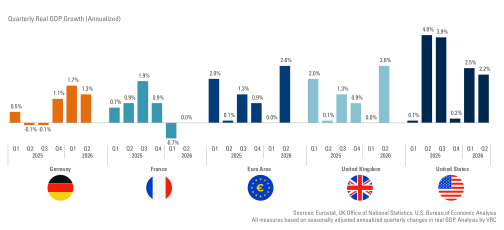
- Household consumption was an important source of strength, supported by lower saving rates. However, the durability of the recent growth remains uncertain. Energy-support measures expired in most countries at the end of the second quarter, while rising inflation and elevated long-term borrowing costs are expected to weigh on demand. In September, the OECD raised its 2026 real GDP growth forecasts to 1.0% for the euro area and 1.1% for the UK, while Germany’s forecast increased by4% to 1.1% (a significant improvement). Despite stronger second-quarter performance, both the euro area and the UK are projected to grow by 1.0% in 2027 in real terms, suggesting that recent momentum is unlikely to translate into a meaningful medium-term acceleration in economic activity.1
Inflationary Pressures Mount, as Energy Price Shock Persists
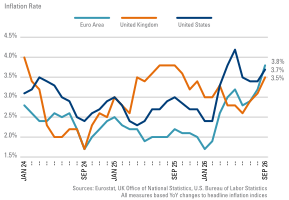 Headline inflation accelerated sharply in the third quarter. Euro area inflation rose from 2.8% in June to 3.8% in September, while UK inflation increased from 2.6% to 3.5%. Energy prices were a big driver, with September year-over-year inflation reaching 18.9% in the euro area, and 17.9% in the UK. Services inflation also remained sticky at approximately 3.2% in the euro area and 3.7% in the UK.
- Energy and food prices present the principal near-term inflation risks, more so in Europe than in the United States. European gas inventories are unusually low ahead of winter (at their lowest level for this time of year in over 15 years, according to the OECD), while a severe heatwave and drought in the past summer reduced crop yields. In the UK, household energy prices are also expected to go up through year-end, as the price cap established by Ofgem, the energy regulator for Great Britain, was increased.2
Interest Rate Outlook
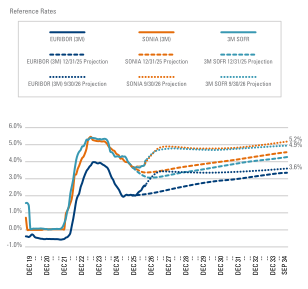 With inflation well-above its 2.0% target, the ECB hiked its deposit rate by 25 bps in both June and September. Markets are pricing in an additional 25 bp rise by December, which would bring the deposit rate to 2.75%. Further rate hikes could occur in 2027, should inflation remain stubbornly high. The BoE held its policy rate at 3.75% in September, although markets continue to anticipate additional tightening during late 2026 and into 2027.
- Spot 3-month EURIBOR rose by approximately 29 bps during the third quarter, from 2.32% to 2.62%, while 3-month SONIA remained near 3.75%. From December 2025 to the end of the third quarter, spot 3-month EURIBOR and SONIA rates have widened by 59 and 3 bps, respectively.
- Forward curves also shifted materially higher relative to year-end 2025. As of September 30, the market-implied 3-month EURIBOR rate for December 2031 was approximately 3.39%, or roughly 38 bps above the year-end 2025 curve. The comparable SONIA forward rate was approximately 4.85%, or about 71 bps higher. This repricing indicates that markets expect elevated policy and reference rates to persist beyond the current tightening cycle.
- The increase in EURIBOR raises debt-service costs for euro-denominated floating-rate borrowers even if credit spreads are stable. The resulting all-in cost of debt is likely to remain high and continue to pressure interest coverage ratios across leveraged capital structures. These conditions highlight the importance of evaluating floating-rate debt exposure, debt-service capacity, and refinancing risk when assessing leveraged borrowers.
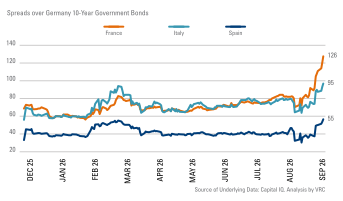
- Long-term sovereign yields have also risen materially during the quarter across major developed economies, including the U.S., Canada, Japan and several European countries. Higher oil prices and renewed inflation pressures help explain the recent surge in long-term sovereign yields, but they are only part of the story. Concerns about the sustainability of government debt across major economies have also become an increasingly important driver of higher yields. Within the euro area, France has been particularly affected, as political appetite to address large budget deficits and rising national debt has weakened amid widespread student and labor union demonstrations tied to affordability concerns. As a result, French 10-year government bond yields rose sharply during September, with investors demanding a significant spread relative to German bonds and increased premiums relative to sovereign yields for Spain and Italy.
- The transmission of higher global yields remains an important downside risk. According to S&P Global Ratings, a persistent 100 bps increase in the U.S. 10-year Treasury yield could reduce euro area and UK GDP growth by about 0.3% and 0.4% respectively, through global financial and trade channels. S&P believes that Germany is particularly exposed through global trade-related channels (with a potential GDP decline up to 0.4%), while the UK and Spain appear more vulnerable through domestic interest-rate and housing market effects.3
Valuation Implications
Europe enters the fourth quarter with stronger near-term growth but a less favorable inflation and interest-rate mix. Resilient consumption is increasingly offset by weaker purchasing power, renewed energy and food-price pressure, and higher financing costs. Growth is therefore likely to remain positive but subdued, with downside risks outweighing upside risks.
For valuation analyses, higher spot rates and forward curves support reassessment of reference-rate assumptions, debt-service capacity, refinancing costs, and discount rates. Despite stable credit spreads in the European Middle Market direct lending market, all-in borrowing costs are likely to rise. These considerations are particularly relevant for highly leveraged borrowers and businesses approaching refinancing events.
In addition, persistently higher long-term sovereign yields are likely to contribute to a higher cost of capital across both public and private markets. Higher discount rates may weigh down M&A and IPO activity, placing further pressure on private equity portfolio company exits.
[1] OECD (2026), OECD Economic Outlook, Interim Report September 2026: Weathering Successive Shocks, OECD Publishing, Paris
[2] Ofgem, “Changes to energy price cap between 1 October and 31 December 2026 “, August 26, 2026. Ofgem regulates the maximum amount energy suppliers can charge households on default tariffs for each unit of energy. Ofgem indicated that from October 1 to December 31, 2026 energy prices would go up by 4% for a typical household using electricity and gas.
[3] S&P Global Ratings, “Economic Research: Economic Outlook Europe Q4 2026: Resilient Demand Meets Persistent Pressure”, September 23, 2026. S&P defined “persistent” as a 100 bps increase in the U.S. 10-year Treasury yield lasting for four quarters.
Explore the Full Market Commentary Series

European Private Market Trends: Q3 2026 Direct Lending & Private Equity Update
Across European private markets, valuation outcomes are increasingly being driven by company-specific fundamentals rather than broad market trends, as access to capital, financing conditions, and credit quality continue to diverge across borrowers.

U.S. Macroeconomic & Interest Rate Trends: Q3 2026
U.S. markets are increasingly balancing resilient economic fundamentals against renewed inflation pressures, rising interest rates, and growing geopolitical uncertainty.

Private Market Trends: Q3 2026 Private Credit & Equity Update
Private credit remains a story of divergence: while refinancing pressure and restructuring activity continue to build among older loan vintages, improving deal activity and substantial private capital dry powder are creating renewed momentum across the market.

Equity Market Trends: Q3 2026 Valuations & Capital Markets Update
Earnings remain strong, but investors are becoming increasingly selective. As valuation multiples moderate and interest rates stay higher for longer, execution, profitability, and business quality are driving value creation more than multiple expansion.

Structured Products Market Trends: Q3 2026 CLO & ABS Update
Resilient demand and favorable liability management opportunities continued to support CLO and ABS markets through the third quarter, although collateral quality, credit dispersion, and borrower-specific risks increasingly differentiated outcomes across sectors and capital structures.