
European Private Market Trends: Q3 2026 Direct Lending & Private Equity Update
November 6, 2026
Estimated reading time: 6 minutes
The article in brief:
- European direct lending conditions remained stable in the third quarter of 2026, although lender competition continued to favor high-quality borrowers, while weaker credits faced widening financing disparities.
- M&A and private equity exit activity remained constrained by valuation gaps, higher financing costs, and geopolitical uncertainty, despite continued pressure on sponsors to deploy capital and generate liquidity.
- Default rates remained modest, but lenders continue to focus workout efforts on highly leveraged 2021-2022 vintages that are navigating a higher-for-longer interest rate environment.
Executive Summary
In this third quarter European Private Market Trends report, VRC reviews developments across European direct lending, private equity (PE), M&A activity, interest rates, and portfolio company performance. Our report highlights the factors influencing financing conditions, transaction activity, and valuation considerations for market participants operating in the current European environment.
- European public credit and equity markets remained stable in the third quarter of 2026, despite renewed inflation concerns and geopolitical uncertainty.
- Direct lending pricing has remained broadly unchanged from 2025 levels, though financing conditions continued to diverge between stronger and weaker borrowers.
- M&A activity remained constrained by valuation gaps, higher financing costs, and macroeconomic uncertainty.
- Economic activity in the Eurozone and the UK proved more resilient than anticipated; however, higher oil prices, rising long-term yields, and renewed inflationary pressures increased downside risks during the quarter. The European Central Bank was forced to resume interest rate hikes, to address rising inflation, with the Bank of England is contemplating doing the same.
- Default activity remained relatively modest, and rating agencies continue to characterize credit deterioration as largely company-specific rather than systemic.
- Workout activity in direct lending remains concentrated among highly leveraged 2021-2022 vintages facing elevated borrowing costs and refinancing challenges.
Explore the Full Market Commentary Series

European Macroeconomic & Interest Rate Trends: Q3 2026

Private Market Trends: Q3 2026 Private Credit & Equity Update
Private credit remains a story of divergence: while refinancing pressure and restructuring activity continue to build among older loan vintages, improving deal activity and substantial private capital dry powder are creating renewed momentum across the market.

Equity Market Trends: Q3 2026 Valuations & Capital Markets Update
Earnings remain strong, but investors are becoming increasingly selective. As valuation multiples moderate and interest rates stay higher for longer, execution, profitability, and business quality are driving value creation more than multiple expansion.

Structured Products Market Trends: Q3 2026 CLO & ABS Update
Resilient demand and favorable liability management opportunities continued to support CLO and ABS markets through the third quarter, although collateral quality, credit dispersion, and borrower-specific risks increasingly differentiated outcomes across sectors and capital structures.

U.S. Macroeconomic & Interest Rate Trends: Q3 2026
U.S. markets are increasingly balancing resilient economic fundamentals against renewed inflation pressures, rising interest rates, and growing geopolitical uncertainty.
Public Market Pricing Trends
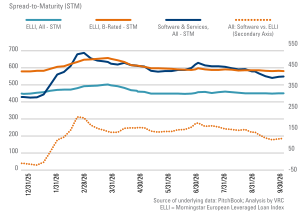 European public markets remained stable during the third quarter of 2026 despite ongoing concerns surrounding inflation, geopolitical risks, and AI-related and technology-sector disruption.
According to PitchBook data, secondary B-rated European credit spreads at the end of September were near year-end 2025 levels, while the MSCI Europe Small and Mid-Cap equity indexes posted strong positive year-to-date returns (in euros). Beneath the surface, however, market performance reflected increasing differentiation among issuers and sectors.
For example, credit spreads for the European Software & Services index widened by nearly 120 basis points from year-end levels and remain approximately 100 basis points wider than the ELLI, All index. Although, both indices improved from their first quarter highs, spreads continue to reflect elevated investor scrutiny of technology-oriented credits.
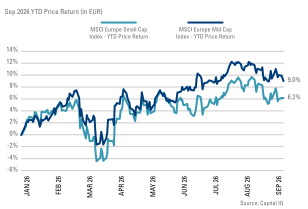 The data suggest investors are becoming increasingly selective rather than broadly risk-averse. For valuation professionals, this growing dispersion reinforces the importance of relying on company-specific market evidence rather than broad sector assumptions when assessing risk, valuation multiples, and market participant expectations.
Direct Lending Pricing Trends
VRC’s proprietary research indicates that European direct lending unitranche pricing remained largely unchanged during the third quarter.
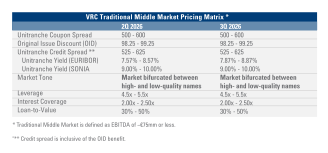
European direct lending pricing has remained broadly stable since 2025, despite periods of volatility in public markets. Abundant dry powder and limited new issuance have kept lender competition elevated and continues to support favorable financing terms for high-quality borrowers.
Conversely, certain companies experiencing operational challenges, elevated leverage, cyclical business pressures, or AI-related business model disruption may face higher financing costs and increased lender scrutiny, with some borrowers experiencing limited access to new financing altogether. Based on market observations, spread premiums can vary materially by industry, geography, and company-specific circumstances.
These conditions have reinforced a market that is increasingly differentiated between stronger and weaker credits. Purchase multiples, credit spreads, and underwriting terms are expected to remain aggressive for high-quality companies, supported by significant undeployed capital across both PE and direct lending markets. Meaningful changes to financing conditions may ultimately depend on increased transaction activity absorbing a larger portion of that available capital.
As a result, financing outcomes are becoming increasingly differentiated across borrowers, contributing to a wider dispersion in market pricing, leverage levels, covenant packages, and underwriting structures. The gap between stronger and weaker credits continues to widen, as lenders apply greater selectivity at both the company and sector level.
From a valuation perspective, this divergence highlights the importance of assessing borrowing costs, leverage capacity, and refinancing risk on a company-specific basis. Market participant assumptions can vary significantly even among businesses operating within the same industry, which may have a meaningful impact on value.
Private Equity & Credit Performance
Direct Lending Deal Volume Trends
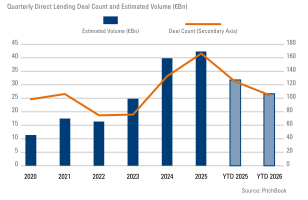 Direct lending deal volume remained below prior-year levels during 2026, with year-to-date 2026 deal volume approximately 16% lower than the comparable 2025 period, according to PitchBook LCD data.
Transaction activity continues to face headwinds from valuation mismatches between buyers and sellers, persistent geopolitical uncertainty, elevated financing costs, and a more selective underwriting environment.
For valuation practitioners, slower deal activity may reduce the availability of recent market transactions and increase reliance on company-specific performance metrics when estimating fair value.
Private Equity Deal Activity & Exit Environment
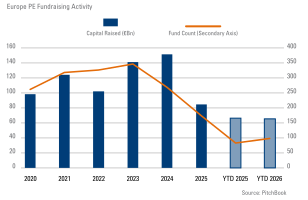
Following a strong third quarter, European PE fundraising is now broadly in line with year-to-date 2025 levels, according to PitchBook data. Nevertheless, fundraising activity remains below the elevated levels observed earlier in the cycle, reflecting continued challenges in generating liquidity from existing portfolio investments.
 According to PitchBook estimates, total European PE exit value increased to €243.5 billion, or 6.5%, through third quarter 2026, compared with €228.8 billion during the comparable prior-year period. However, exit count declined by 4.9%.
As a result, average exit size increased approximately 12% to €195.0 million, from €174.1 million.
This divergence suggests that improvements in aggregate exit value have been concentrated in larger transactions, while much of the broader market continues to face realization challenges.
Against this backdrop, PE firms continue to explore alternative liquidity solutions including dividend recapitalizations, NAV financing facilities, minority stake sales, and continuation vehicles.
Direct lenders remain willing participants in many of these transactions but continue to evaluate structural complexity, governance considerations, and alignment of stakeholder interests on a case-by-case basis.
European M&A and Direct Lending Outlook
The outlook for M&A and alternative PE investment exit strategies became more uncertain during the quarter, prompting direct lenders to concentrate on disciplined due diligence efforts.
Nevertheless, transaction pipelines remain active.
Should macroeconomic and geopolitical conditions stabilize, several factors could support improved activity levels, including:
- Prolonged holding periods across PE portfolios;
- Increasing pressure on sponsors to return capital to investors;
- Approaching debt maturities;
- Substantial PE and direct lending dry powder; and
- Borrowing costs that remain below peak 2024 levels.
Whether these factors ultimately translate into increased transaction volumes will depend largely on financing conditions, valuation expectations, and broader economic developments.
Interest Rate Outlook: Higher-for-Longer
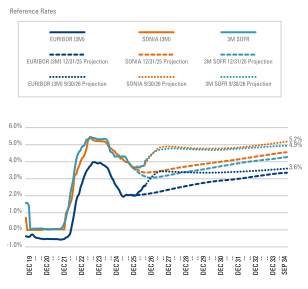 Market interest rate expectations moved higher during the quarter as inflationary pressures intensified and central banks responded accordingly.
The European Central Bank increased policy rates by 25 basis points in both June and September 2026, while market participants increasingly anticipate a prolonger higher-rate environment.
From December 2025 to the end of the third-quarter, spot 3-month EURIBOR and SONIA rates have widened by 59 and 3 basis points, respectively. Based on year-end comparisons of 2025 versus 2031, longer-term forward curves also imply higher expected rates of ~38 basis points for and ~71 basis points relative to year-end 2025 assumptions.
The resulting all-in cost of debt is likely to remain high and continue to pressure interest coverage ratios across leveraged capital structures.
For valuation analyses, sustained borrowing costs may influence discount-rate assumptions, expected capital structures, and assessments of debt-service capacity. These considerations are particularly relevant for highly leveraged borrowers and businesses approaching refinancing events.
VRC explores some of these developments in greater detail in its inaugural European Macroeconomic & Interest Rate Trends: Q3 2026 report.
Portfolio Company Performance and Default Trends
Despite a more challenging backdrop, direct lenders generally expect portfolio company performance to remain stable.
Headwinds persist, including higher interest rates, inflationary pressures, elevated energy costs, and geopolitical uncertainty. However, most lenders continue to characterize these pressures as company-specific rather than systemic.
Many direct lenders also note that AI-related considerations have been incorporated into underwriting processes for some time. As a result, loans have largely been extended to companies with low exposure, strong moats, or potential benefits (i.e., significant regulatory or compliance component, proprietary data, or material customer interaction).
Default rates remain relatively modest by historical standards.
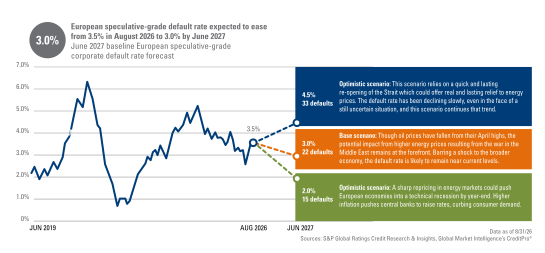 S&P Global Ratings recently projected the European speculative-grade default rate to ease to 3.0% by June 2027 from 3.5% in August, while Fitch Ratings forecasts a more elevated 4.0% to 4.5% default rate for European leveraged loans during 2026 (a deterioration from their August levels). Both agencies continue to emphasize that refinancing markets remain accessible for stronger issuers, while weaker borrowers face more challenging funding conditions.
The divergence between stronger and weaker credits is particularly evident in workout activity.
Direct lending workouts remain concentrated among 2021-2022 post-COVID vintages, where elevated leverage and higher interest costs have placed pressure on capital structures.
Sponsors and direct lenders continue to pursue a range of solutions, including:
- PIK toggles;
- Maturity extensions;
- Sponsor equity infusions;
- Enhanced liquidity monitoring; and
- Covenant amendments.
These transactions are typically designed to preserve liquidity, reduce near-term cash interest burdens, and, where new equity infusion or debt paydown is involved, deleverage the capital structure.
In exchange for providing additional flexibility, direct lenders typically receive incremental economics such as PIK premiums, amendment fees, or principal repayments, together with enhanced lender protections, which may include sale milestones, trigger-based liquidity infusions, increased reporting requirements, and tighter covenants.
While these collaborative solutions have helped in limiting payment defaults, some situations may ultimately require debt-for-equity swaps or additional liability management exercises.
From a valuation standpoint, these developments reinforce the importance of evaluating liquidity, refinancing alternatives, debt maturity schedules, and stakeholder economics when assessing private company and credit valuations.
Final Thought
As financing conditions, credit quality, and access to capital become increasingly differentiated across borrowers, valuation outcomes are being driven less by broad market trends and more by company-specific fundamentals, making disciplined analysis of cash flow durability, leverage, liquidity, and refinancing risk more important than ever.