
Structured Products Market Trends: Q2 2026 CLO & ABS Update
Estimated reading time: 15 minutes
The article in brief:
- Collateralized Loan Obligation (CLO) issuance and pricing reflect a more selective environment in 2026. Year-to-date issuance trails 2025 levels amid weaker credit fundamentals and market volatility, with managers increasingly favoring refinancings over resets. Spread dynamics highlight growing dispersion, with stability in senior tranches contrasted by widening spread trends across the capital stack for middle market CLOs driven by credit differentiation and a growing distressed tail of underlying loans.
- Credit dispersion and capital structure selectivity are defining market behavior across structured products. In both CLO and Asset-Backed Securities (ABS) markets, investor demand remains concentrated in senior tranches, while risk appetite for mezzanine and subordinate exposures is increasingly influenced by collateral quality, sector concentration, and structural considerations. This dynamic is particularly evident in ABS, where spread performance has become increasingly bifurcated across collateral types.
- ABS markets remain active, but issuance growth is broadening and increasingly sector-specific. Total ABS issuance is running ahead of levels seen in prior years, supported by diversification beyond Auto ABS into sectors such as Data Center, Aircraft, and Student Loan ABS. At the same time, issuance remains uneven, with policy-sensitive and higher-risk sectors—such as Credit Card and Small Business Loan ABS—showing weaker activity, reinforcing a more selective and differentiated market environment.
Primary and Secondary CLO Market Trends and Issuance Overview
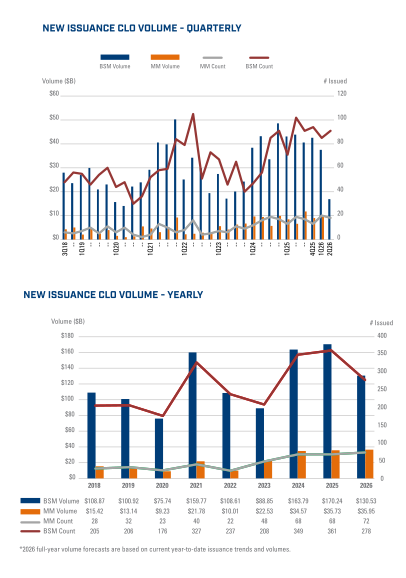 Since, January 1, 2026, VRC has observed 146 new issue U.S. CLOs price, totaling approximately $69 Billion in issuance. Volumes remain below the same period in 2025 (approximately $102 billion), while full-year 2025 issuance reached approximately $206 billion, representing the largest year of CLO issuance on record.
The lower year-to-date 2026 issuance reflects weaker prior-year levels of weaker credit fundamentals and tighter arbitrage conditions that are constraining the pace of new CLO formation. At the same time, market volatility—partly associated with uncertainty surrounding potential artificial intelligence–related disruption and broader macroeconomic dynamics—has created a less constructive environment for CLO formation. In response, many managers have delayed issuance activity while monitoring execution levels and market stability, highlighting that market conditions and arbitrage compression are informing CLO formation decisions in 2026.
Additional pressures include weakening CLO equity distributions, deterioration in overcollateralization cushions, and continued focus on distressed tail risk within underlying loan portfolios. Despite these headwinds, sustained issuance activity in recent years has expanded both the manager universe and the investor base. Senior debt tranches have experienced limited spread volatility, which has supported durable investor relationships and the continued development of dedicated capital across the CLO market.
Across the capital structure, demand remains concentrated in senior (AAA–A) tranches, reflecting investor preference for liquidity and lower credit risk in the current market environment. At the margin, activity has also begun to rotate toward mezzanine tranches as relative value has improved. However, investor participation in these tranches remains uneven, reflecting ongoing concerns regarding loan credit quality, sector concentration, and broader dispersion across underlying assets.
Overall demand continues to reflect a balance of structural and cyclical factors, including investor preference for floating-rate assets, central bank policy conditions, and the CLO market’s capacity to absorb primary loan issuance. Within this context, demand appears increasingly calibrated to prevailing market conditions, rather than expanding in line with prior-year issuance levels.
Refinancing and reset activity remained elevated in 2025, but the dynamic has shifted through 2026. Managers are increasingly pursuing refinancing transactions on an opportunistic basis to reduce liability costs, rather than extending reinvestment periods, reflecting a shift toward liability management as a primary driver of CLO activity in 2026. Through May 31, 2026, total reset volume reached approximately $82.0 billion, compared with nearly $100.5 billion during the same period in 2025, a decline of roughly 18% year over year. In contrast, year-to-date 2026 refinancing volume totaled approximately $57.5 billion, exceeding the $46.5 billion observed over the same period in 2025, approximately 23% lower year over year.
Middle market (MM) CLO issuance reached record levels in 2025, with 68 transactions totaling approximately $35.7 billion. Despite some uncertainty in the private credit market, issuance activity had remained strong through the month-end of May 2026, with 30 MM CLOs priced totaling approximately $15.0 billion since January 1, 2026, compared with 26 new-issue transactions totaling near $13.0 billion through the end of May 2025. This pace represents a continued expansion in the share of total CLO issuance captured by MM transactions and establishes a new high watermark for MM participation within the market further highlighting the growing role of private credit and direct lending in the CLO market composition.
MM CLO issuance increased from approximately 8% of total supply in 2022 to approximately 20% in 2023, supported by sustained demand for middle market and direct lending platforms. This elevated share has remained stable in 2026, at approximately 21% year to date. Based on discussions with market participants, MM CLO volume relative to total issuance may continue to represent approximately one-fifth of total supply, reflecting a sustained structural shift in how CLO issuance is distributed across the broadly syndicated loan (BSL) and private credit markets.
Market participants generally expect macroeconomic conditions seen in the first half of 2026 to remain constrained by softer loan market fundamentals, elevated inflation, and sector-specific risks, alongside ongoing geopolitical uncertainty. These pressures may offset otherwise supportive CLO market fundamentals, including ETF and annuity inflows, elevated all-in base rates, and strong underlying liquidity conditions.
Within this context, overall 2026 CLO issuance, including new-issue and reset activity, may remain below the record levels observed in 2024 and 2025, while refinancing activity could represent a greater share of total volume. Based on market commentary, refinancings are expected to outpace resets as managers continue to evaluate market value overcollateralization (MVOC) dynamics in seasoned mezzanine tranches. At the same time, demand for mezzanine debt has shown signs of improvement since the first quarter of 2026, supported by observed ETF flows and secondary trading activity.
The CLO market continues to reflect a balance between evolving credit conditions and durable structural demand for syndicated loan exposure, with issuance activity and capital structure dynamics adjusting accordingly.
Primary U.S. CLO Transactions, Pricing, and Credit Spread Trends
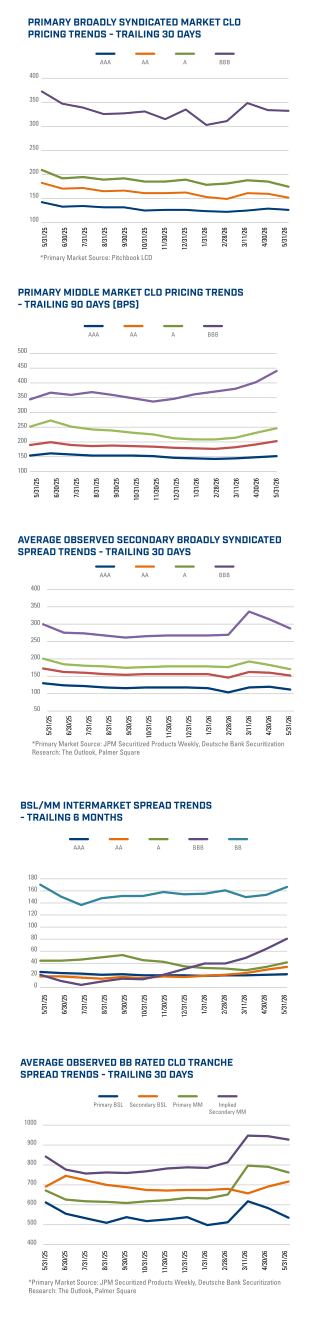 Primary tranche spreads have generally widened since mid-February lows, reflecting continued concerns related to credit fundamentals, macroeconomic conditions, and AI disruption within the software sector. Spread movements were more pronounced in the MM segment, while BSL CLO spreads remained comparatively more stable. BSL AAA spreads have remained broadly consistent with levels observed as of March 31, 2026, while MM AAA spreads have moved modestly higher, reflecting investor preference for more liquid exposures and continued aversion to credit dispersion within the MM market.
In the secondary market, BSL CLO spreads were tighter relative to second quarter 2025 highs, with greater spread compression observed in senior tranches. Since March 31, 2026, implied secondary spreads have generally trended tighter across the capital structure, with mezzanine tranches experiencing the greatest degree of contraction. This tightening appears to reflect a combination of reduced market value overcollateralization (MVOC) concerns relative to those in the first quarter and more attractive yields, which have supported incremental investor demand for lower-rated tranches to generate alpha, particularly as investors seek higher-yielding opportunities amid stabilizing risk conditions.
Intermarket tranche differentials between BSL and MM CLOs widened over the past three months. This divergence reflects increased credit dispersion, continued investor caution toward private credit–related dynamics, and the relative liquidity advantage of the BSL market. Compared with the first quarter of 2026, spread widening has been more pronounced in MM CLO tranches, particularly in lower-rated tranches, where a growing tail of distressed loans trading below 80 continues to influence pricing and investor positioning, highlighting increased dispersion in downside risk across CLO portfolios.
CLO Market Fundamentals by Vintage - BSL
As a snapshot of current market conditions, we reviewed key CLO metrics across vintages from 2018 through 2026. Within the available data set, more recent vintages (2024–2026) exhibit lower weighted average asset spread (WAAS) levels relative to earlier vintages (2018-2023), reflecting tighter loan pricing trends observed in the leveraged loan market in recent years.
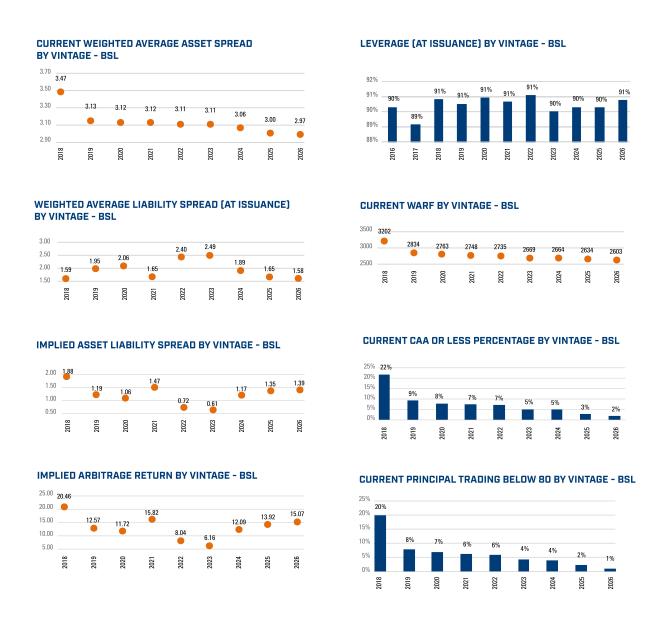 Since the first quarter of 2026, earlier vintages (2018–2021) have experienced declines in WAAS, driven in part by higher coupon deals refinancing out of the seasoned collateral pools following market volatility since March 2026. At the same time, weighted average rating factor (WARF) levels remain elevated in older vintages, as higher-quality loans in the collateral pools continue to repay.
At issuance, weighted average liability spread (WALS) levels peaked in the 2022 and 2023 vintages and have declined through the second quarter of 2026. This transition has supported relatively higher BSL CLO implied arbitrage levels in 2025 and 2026 vintages compared with 2022–2024 cohorts, reflecting lower WALS levels observed. This dynamic helps explain differences in risk and return characteristics between newer and more seasoned CLO vintages.
The 2018 BSL CLO vintage continues to exhibit the highest WAAS levels, as well as the highest Caa% exposure, WARF, and principal of loans trading below 80, which is consistent with expectations for more seasoned transactions. Across vintages, Caa% exposure and principal trading below 80 declined over the most recent quarter, reflecting BSL CLO market deal fundamentals and the recovery of loan prices relative at March 31, 2026.
Based on discussions with collateral managers and other market participants, several themes continue to influence BSL CLO fundamentals. While overall CLO performance has been robust, market participants highlight increased risk associated with a meaningful portion of loans maturing prior to 2028. In addition, continued focus remains on software sector exposure and the potential implications of AI–related disruption and credit fundamentals.
Collateral managers also report elevated levels of liability management exercise (LME) activity, along with more frequent sector-specific analysis, particularly following volatility observed in the software sector during the first quarter of 2026. In this environment, managers are attempting to generate alpha by pursuing a more defensive and selective approach to portfolio construction and risk allocation, emphasizing higher-quality, liquid loans and targeting dispersion-driven relative value opportunities as sector and borrower performance diverges, reflecting increased borrower-specific risk and dispersion across sectors.
CLO Market Fundamentals by Vintage - MM
Trends in the MM CLO segment broadly mirror those observed in the BSL market, although dispersion across vintages remains more pronounced. Older vintages continue to maintain higher WARF levels, while more recent vintages exhibit greater volatility, reflecting a more competitive lending environment and increased participation in the MM space. Legacy MM CLO deals continue to de-risk over time as assets amortize and repay, or as managers call older deals and redeploy remaining assets into new CLO structures.
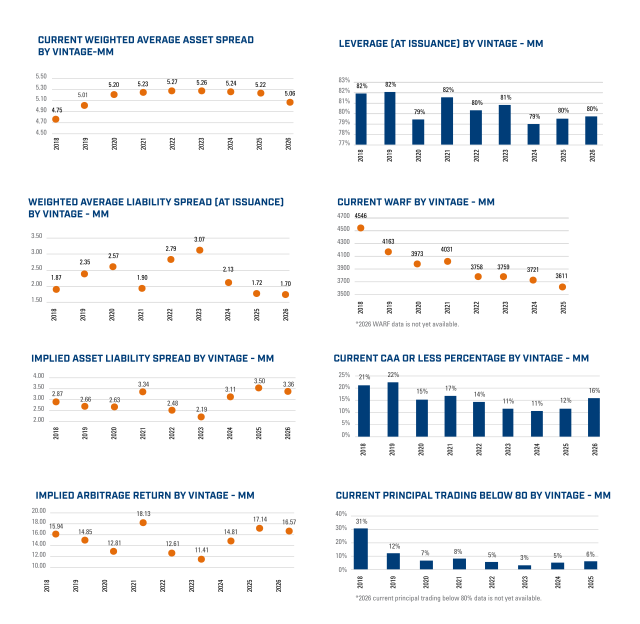 Caa- and CCC-equivalent exposure in 2026 vintages is higher relative to 2023–2025 cohorts, and recent vintages experienced modest increases over the past quarter, while older vintages showed some improvement. The percentage of assets trading below 80 remains lower across 2020–2025 vintages overall; however, 2021 and 2025 vintages continue to exhibit the highest levels among post-pandemic cohorts.
Although more recent 2025 vintages would typically be expected to demonstrate lower levels of discounted assets, competitive underwriting conditions and elevated sector concentration—particularly in software—have resulted in a higher share of lower-priced assets in the 2025 vintage relative to 2022–2024 cohorts. That said, improved loan price performance since the first quarter of 2026 has contributed to modest improvement in these metrics.
WAAS levels have increased across several recent vintages, implying higher income generation for comparable risk profiles. However, until 2024, this benefit was largely offset by expanding CLO debt tranche coupon spreads and expanding discount margins on junior tranches. In contrast, WAAS for the 2026 vintage is modestly lower relative to prior vintages, reflecting tighter loan spreads following the first quarter 2026 market dislocation.
WALS levels declined across 2024–2026 vintages relative to peaks observed in 2022 and 2023, reflecting the impact of easing monetary policy conditions. This decline supports relatively improved arbitrage return dynamics in newer vintages (2024-2026), although the benefit is more limited in 2026 given lower WAAS levels.
ABS Credit Spread Trends by Sector
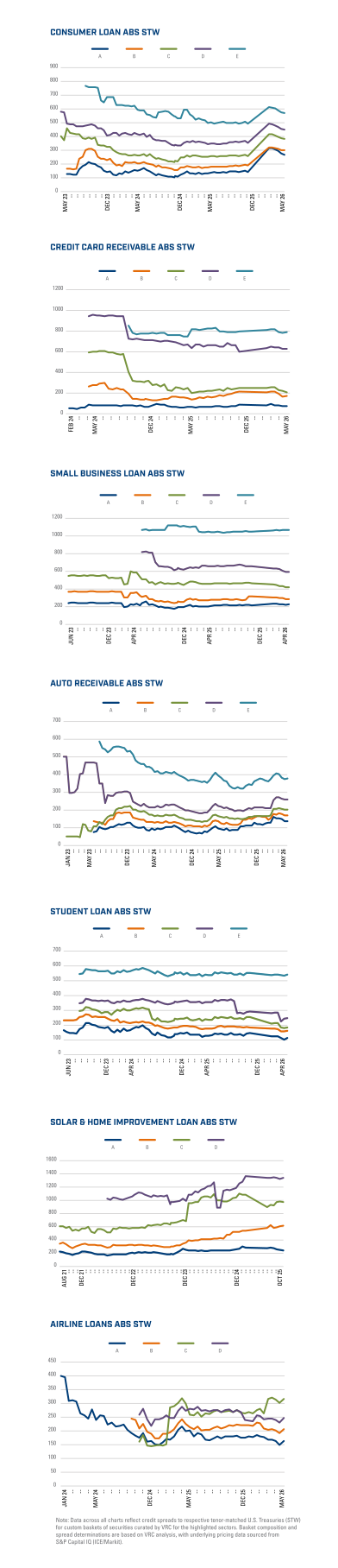 Asset-Backed Securities (ABS) spread performance has been fragmented across collateral types and tranche seniority in the capital structure, reflecting increasing divergence in credit quality, funding conditions, and sector-specific risks across the ABS market. While spreads across the broader ABS market widened during the 2022–2024 rate hiking cycle, the normalization that began in 2024 has not progressed uniformly through 2026. Senior tranches generally continue to demonstrate relative stability; however, the degree of resilience varies meaningfully by sector.
Credit Card ABS A tranches remain near five-year lows, while senior spreads in Auto ABS and Student Loan ABS have moderated and modestly tightened from recent previous quarter-end levels. In contrast, senior spreads across Consumer Loan ABS, Small Business Loan (SBL) ABS, and Solar & Home Improvement (Solar & HI) ABS remain elevated relative to more liquid consumer sectors. Solar & HI and Consumer Loan ABS continue to stand out as higher-beta collateral types, with spread levels reflecting not only underlying credit considerations but also ongoing concerns related to originator and servicer stability.
A notable shift in market behavior is the transition from broad-based spread normalization toward more pronounced sector-level dispersion. Spreads increasingly reflect a divergence between more seasoned collateral types exhibiting stable performance and sectors facing idiosyncratic pressures related to credit performance, funding conditions, and business model durability, as outcomes are driven more by collateral-specific fundamentals than broad market trends.
Auto ABS continues to warrant close attention. Spreads widened meaningfully relative to year-end 2024 levels, particularly in subordinated tranches, although some retracement has occurred since the first quarter of 2026. Solar & HI ABS remains one of the clearest examples of sustained sector-specific spread pressure, with mezzanine and junior tranches continuing to reflect elevated risk premiums following well-publicized industry challenges, ongoing concerns around originator viability, counterparty exposure, and collateral performance.
Airline ABS continues to present a more constructive relative-value profile, although performance has become more differentiated across the capital stack. Spreads have tightened significantly from levels observed between late 2022 and early 2024, supported by strong aircraft demand, constrained supply growth, elevated travel activity, and improving collateral values. These conditions have supported recovery expectations as well as debt service coverage ratios and loan-to-value metrics. This helps explain why Airline ABS has outperformed many other esoteric ABS sectors during the current cycle.
More recently, however, the pace of spread tightening has become less uniform. Senior A and B tranches have improved relative to year-end 2025 levels, while C and D tranches have been more range-bound or modestly wider. This pattern suggests continued investor selectivity when allocating capital to lower-rated tranches. While Airline ABS remains comparatively well positioned when measured against more troubled esoteric sectors, further spread tightening appears more dependent on transaction-specific factors—including collateral quality, structure, and transaction-specific technical performance—rather than broad sector beta alone.
Across the ABS market, junior tranches continue to provide the clearest indication of underlying risk sentiment, as investors demand higher compensation for exposure to credit volatility and structural leverage. Risk premiums remain elevated across several collateral categories despite broader stabilization in senior spreads. Within D and E tranches, the market continues to differentiate sharply by collateral type.
SBL ABS remains among the most stressed segments, with E tranche spreads exceeding 1,000 basis points, indicating that investors continue to require substantial compensation for exposure to small business credit performance and structural leverage. Solar & HI ABS spreads also remain materially wide, particularly in B through D tranches, reflecting persistent concerns regarding sector fundamentals and issuer distress.
Credit Card ABS presents a more mixed profile. Senior and mezzanine tranche spreads have tightened, while D and E tranche spreads remain elevated in absolute terms. This dynamic suggests that, despite stability in senior bond exposures, investors remain cautious with respect to deeper consumer credit risk. Auto ABS junior tranche spreads remain wider than year-end 2024 levels, although partial retracement in 2026 indicates some moderation from earlier risk-off conditions. By contrast, Student Loan ABS has been comparatively more constructive, with spreads tightening across most tranches through 2026 despite continued uncertainty related to borrower delinquencies and policy uncertainty.
Through the second quarter of 2026, ABS spreads are best characterized as mixed and increasingly bifurcated, rather than moving in a single direction. The most notable year-to-date developments include retracement in Student Loan ABS, continued resilience in Credit Card ABS senior tranches, partial recovery in Auto ABS from first-quarter widening, and ongoing weakness in Solar & HI and SBL subordinated tranches. Consumer Loan ABS experienced pronounced widening into the first quarter of 2026 followed by a partial retracement, reflecting a combination of spread volatility, underlying basket collateral composition, and investor sensitivity to unsecured consumer credit exposure at current spread levels.
Inter-tranche spread premiums have normalized in select senior and mezzanine cohorts but remain historically elevated in certain junior segments, particularly SBL E, Solar & HI B through D, and Credit Card D and E tranches. Overall, the broad spread compression observed in 2024 has evolved into a more selective environment in 2026. Investor demand remains concentrated in senior ABS tranches, while risk appetite for subordinated exposures is increasingly driven by collateral-specific factors.
In this environment, the market appears to differentiate more explicitly between sectors with stable collateral performance and transparent structural features and those facing challenges related to borrower credit quality, originator economics, or ongoing uncertainty in policy and business models.
ABS Issuance Trends and Market Volume
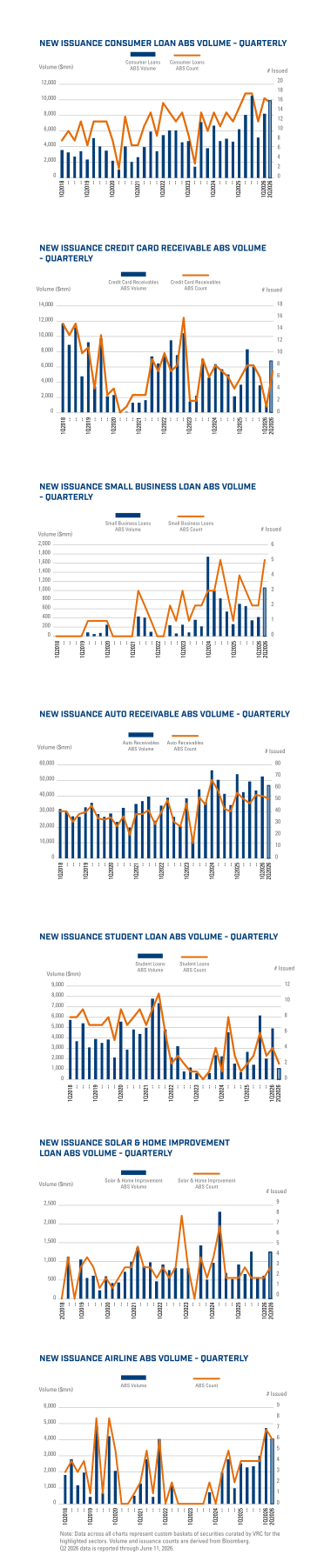 ABS issuance has remained active through early June 2026, reflecting continued demand for securitized funding alongside evolving capital market conditions.. Full-year 2025 represented a record period for the market, with approximately $339 billion of gross issuance, reflecting an increase of roughly 7% compared with 2024 levels and approximately 32% compared with 2023 levels. Through the latest 2026 year-to-date period, total issuance of approximately $167.8 billion is running ahead of both 2025 and 2024 year-to-date levels, representing growth of approximately 16% and 4%, respectively.
Auto ABS continues to represent the largest issuance category, with approximately $81.2 billion issued year-to-date. However, its share of total issuance has declined to approximately 48%, compared with roughly 57% in both 2024 and 2025 year-to-date periods. This shift reflects not a contraction in auto issuance volumes, which remain relatively stable, but rather a broadening of issuance activity across other ABS sectors.
Issuance growth has become increasingly diversified beyond autos. Student Loan ABS, Consumer ABS, Data Center ABS, and Aircraft ABS have each contributed more meaningfully to overall issuance volumes in 2026. Aircraft ABS issuance increased approximately 138% year-over-year, Data Center ABS increased approximately 31%, and Student Loan ABS more than doubled year-over-year. Taken together, these trends suggest that the ABS market is not only expanding, but also evolving toward a more diversified mix of collateral types, with growth driven by sector-specific funding needs and investor demand. By contrast, Credit Card ABS issuance has been comparatively weak year-to-date, declining approximately 34% year-over-year, while SBL ABS remains a relatively small and declining contributor to overall issuance.
Within Auto Receivables ABS, issuance volume has remained stable, but the declining share of overall ABS issuance is more notable than any change in the internal prime/non-prime composition of the sector. Year-to-date issuance of approximately $81.2 billion is only modestly below the $81.7 billion observed during the same period in 2025.
The composition of issuance has also remained relatively consistent, with prime auto loans representing approximately 44% of volume, non-prime loans approximately 23%, and other auto collateral approximately 33%. This stability suggests that the relative decline in auto’s share of total issuance is driven primarily by growth in other sectors, rather than shifts within the auto market itself. This mix remains broadly consistent with 2025 year-to-date levels, suggesting that the modest decline in volume is not driven by shifts in prime versus non-prime issuance.
This distinction helps explain why Auto ABS remains stable in absolute issuance levels while representing a declining share of total market growth.
Rather, the more relevant takeaway is that the Auto ABS market remains deep and liquid, but no longer accounts for the same proportion of overall market share.
Outside of autos, stronger issuance trends are concentrated in sectors associated with broader capital investment and consumer balance sheet activity. Equipment ABS increased approximately 6% year-over-year, Other Commercial ABS increased approximately 81%, and Data Center ABS continued to expand as a securitization channel, reflecting elevated infrastructure investment and technology-related capital needs. Consumer ABS also recorded steady growth, supported by ongoing consumer borrower demand and the continued relevance of term ABS as a funding source.
Several smaller or more policy-sensitive sectors warrant closer attention, as issuance trends appear to reflect underlying structural and regulatory considerations in addition to typical market dynamics. Student Loan ABS issuance rebounded sharply in 2026, reaching approximately $5.8 billion year-to-date, an increase of approximately 146% year-over-year, suggesting increasing reliance on private markets amid ongoing policy uncertainty in the federal student loan landscape. While still representing a relatively small share of total ABS issuance (approximately 3.5%), this growth indicates that private-market activity is becoming more relevant as the broader policy environment continues to evolve.
In contrast, Credit Card ABS issuance has been comparatively subdued, totaling approximately $6.2 billion year to date, or approximately 3.7% of total issuance. This represents a decline from approximately 6.5% of total ABS share in 2025 and approximately 7.0% in 2024. The weakness in issuance occurs alongside rising consumer credit balances and may reflect a combination of issuer funding preferences, relative securitization economics, and ongoing regulatory or policy uncertainty, which collectively reflect how funding preferences, securitization economics, and regulatory considerations are influencing issuance decisions in consumer credit ABS markets.
SBL ABS and Solar & Home Improvement ABS remain relatively small contributors to overall issuance. SBL issuance has declined on a year-over-year basis, while Solar & HI issuance has increased modestly from a lower base. Across these sectors, issuance activity appears more constrained, consistent with ongoing credit concerns and sector-specific operating challenges.
Overall, year-to-date 2026 issuance trends suggest that the ABS market remains active and well supported, but increasingly selective, with issuance patterns reflecting differences in credit quality, policy exposure, and structural funding demand across sectors. Growth is most evident in sectors aligned with structural funding demand or expanding institutional participation, while issuance in more policy-sensitive or credit-sensitive sectors remains uneven. Taken together, these dynamics point to a market that continues to evolve in response to underlying credit conditions, funding considerations, and broader economic forces.