
Functional Obsolescence in Machinery and Equipment Valuations
Estimated reading time: 4 minutes
The article in brief:
- Functional obsolescence reduces the value of machinery and equipment that remains operational but is less efficient, more costly, or otherwise inferior to modern alternatives.
- Common indicators include outdated technology, excess capital or operating costs, inefficient design, and capacity that exceeds production requirements.
- Identifying and quantifying functional obsolescence supports credible fair value conclusions for purchase price allocations, impairment testing, financial reporting, and other asset valuations.
Why Functional Obsolescence Matters
Functional obsolescence can significantly affect the valuation of machinery and equipment, particularly in ASC 805 purchase price allocations and ASC 360 impairment testing. Failure to identify and quantify functional obsolescence may overstate asset values, increase audit scrutiny, and undermine the appraisal’s usefulness and credibility.
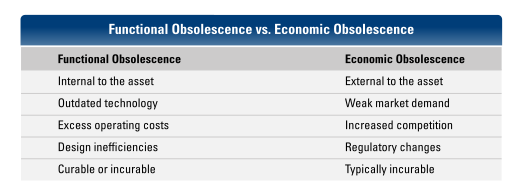
When determining fair value for ASC 805, valuation professionals typically use the cost approach, which considers physical deterioration, functional obsolescence, and economic obsolescence as separate forms of accrued depreciation. Physical deterioration, or depreciation, is the normal wear and tear that diminishes an asset’s value over time. Economic obsolescence is the loss in value caused by factors external to the asset, such as changes in market demand, raw material availability, or regulatory conditions. This article focuses on functional obsolescence.
What Is Functional Obsolescence?
Functional obsolescence occurs when an asset provides less utility than a modern equivalent because of deficiencies in design, technology, capacity, configuration, or operating efficiency.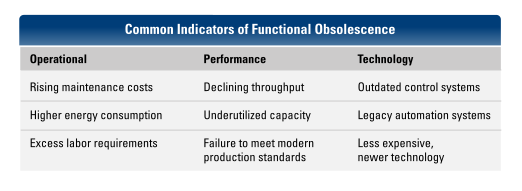
Types of Functional Obsolescence and How to Measure Them
The following examples illustrate both the various forms of functional obsolescence and the methods appraisers use to measure their impact on value. Common quantification techniques include the cost-to-cure method, capitalization of excess operating costs, and capacity utilization analysis.
Functional obsolescence may be either curable or incurable. Curable functional obsolescence exists when the cost to remedy the deficiency is less than the resulting increase in value. Incurable functional obsolescence exists when correction is not economically justified.
Consider a milling machine whose capacity is limited by an outdated computer numerical control (CNC) system. Upgrading the CNC system increases the machine’s capacity. This is the easiest form of functional obsolescence to quantify if the cost of the necessary upgrade can be identified directly.
Excess Capital Costs
Equipment appraisers differentiate between reproduction cost (the cost to reproduce the same asset) and replacement cost (the cost to replace an asset with one providing the same utility). The difference between an asset’s reproduction cost and the lower cost of a modern equivalent replacement may indicate functional obsolescence from excess capital costs.
A photovoltaic (PV) power facility provides a useful example. Technology advances and economies of scale have drastically reduced PV construction costs. Facilities that cost approximately $6.50 per watt to build in 2010 can now be constructed for around $1.10 per watt1. Although older PV facilities may still have decades of economic life remaining, replacing their generating capacity costs a fraction of their original construction cost.
Excess Operating Costs
An obsolete asset may consume significantly more labor, energy, maintenance, or raw materials than one with new technology or superior design while producing the same output.
In one engagement, we valued several paper mills, some more than 100 years old. Over decades of expansions and reconfigurations, these facilities developed inefficient layouts and incorporated outdated technologies, both of which indicated functional obsolescence. At one of these older mills, production costs were $750 per ton, compared with $700 per ton at a modern facility. With annual production of 100,000 tons, the excess operating cost equals $5 million annually. Capitalizing this differential may indicate a functional obsolescence adjustment.
This assessment was validated by comparing the older mills’ production costs per ton to those of newer mills producing similar products. The resulting excess operating costs were then used to quantify the functional obsolescence adjustment.
Excess Capacity
The loss in value due to excess capacity in a production plant most often results from economic obsolescence—factors external to the assets, such as changing demand or industry economics.
However, excess capacity in a single asset within a production plant indicates functional obsolescence and reduces that asset’s value.
Consider a brewery bottling line where the filling equipment processes 1,000 bottles per minute while the capping machine is capable of processing 2,000 bottles per minute. Because the capping machine’s capacity substantially exceeds system requirements, a portion of its installed capacity provides no economic benefit. A prudent investor would not pay full value for unused capacity, so a functional obsolescence adjustment is warranted.
Functional Obsolescence vs. Economic Obsolescence
Distinguishing functional obsolescence from economic obsolescence is critical in machinery and equipment valuation because the source of value loss affects both the analysis and the conclusion of value. Although a single asset may experience both economic and functional obsolescence simultaneously, they arise from different causes and must be analyzed and measured separately.
Consider a chemical plant built for $200 million and designed to produce 100,000 metric tons (MT) of product per year. Subsequent environmental regulations limited the plant’s permitted output to 50,000 MT per year, or 50% of its rated capacity. Because this loss in utility resulted from an external regulatory factor, the resulting loss in value represents economic obsolescence.
To address this limitation, the company invested $20 million in upgrades to raise the plant’s permitted capacity to 80,000 MT per year. After installing the new equipment, regulatory constraints were no longer the primary limitation. However, most of the facility’s existing equipment remained designed for 100,000 MT per year and could now operate at only 80% of its rated capacity. The resulting underutilization represents functional obsolescence because it arises from the configuration and capacity characteristics of the assets themselves rather than from an external market or regulatory condition.
Functional Obsolescence in ASC 805 Asset Valuations
There are two primary reasons for considering functional obsolescence in machinery and equipment valuations. First, it helps ensure an asset’s fair value reflects market participant assumptions and the factors a prudent buyer would consider when determining a business’s purchase price. The value assigned to individual assets should be consistent with those considerations. Second, failure to consider all forms of depreciation in an initial fair value measurement may result in future asset write-downs during impairment testing.
Conclusion
While physical deterioration is often apparent, functional obsolescence frequently requires deeper analysis. Identifying excess costs, outdated technology, inefficient design, and underutilized capacity helps ensure machinery and equipment values reflect market participants’ assumptions and support credible fair value conclusions.
How VRC Can Help
VRC’s Machinery & Equipment practice group is composed of senior professionals with decades of specialized industry experience, having executed thousands of engagements ranging from single-location assignments to portfolios with thousands of properties, including individual assignments exceeding $10 billion in value. VRC has experience valuing a full range of M&E assets across industries such as renewable energy, chemical and pharmaceutical plants, sawmills and paper mills, vehicle fleets, production and process equipment, steel mills, retail, medical operations, and other specialty and niche businesses.
Contact the author or any VRC professional to discuss your asset valuation challenges.
1 NREL: National Renewable Energy Laboratory