
How Wealth Management Firms Are Valued: Key Drivers, Methods, and Market Trends
Estimated reading time: 6 minutes
The article in brief:
- Continued consolidation in the wealth management industry has increased buyer selectivity, with premium valuations increasingly reserved for firms that demonstrate sustainable growth, scale, and operational sophistication.
- Firms with similar Assets Under Management (AUM) can generate materially different valuations due to differences in risk profile, management depth, client characteristics, and growth prospects.
- Valuation professionals typically rely on the income and market approaches to value wealth management firms, carefully evaluating forecast risk, management and client characteristics, and comparable transaction data.
Continued consolidation in the wealth management industry, rising private equity investment, and a growing wave of advisor retirements have increased the importance of understanding firm value. As transactions become more competitive, buyers and sellers are placing greater emphasis on earnings quality and sustainability rather than AUM alone.
Two wealth management firms can oversee similar AUM yet receive materially different valuation conclusions. While AUM remains an important measure of scale, growth quality, client relationships, management depth, and overall risk profile often drive value. This distinction matters more as acquirers grow more selective. In today’s market, firms with sustainable organic growth, diversified client relationships, and scalable operating infrastructure often command premium valuations, while firms with a concentration of clients, founder dependence, or less predictable cash flows may receive significant valuation discounts.
Why Similar Firms Can Have Very Different Values
Consider two wealth management firms. One firm has a long operating history, diversified clients, recurring fee-based revenue, and an experienced management team. The second firm is newer, relies heavily on a small client base, and depends on a limited number of professionals to maintain client relationships.
Although both firms provide advisory services, buyers and valuation professionals would likely assess their risk profiles very differently. As a result, the firms could generate substantially different valuation multiples and valuation conclusions despite operating in the same sector.
Value is driven not only by AUM, but also by growth sustainability, client stability, profitability, organizational depth, and risk. The valuation approaches discussed below help quantify those drivers.
How Are Wealth Management Firms Valued?
Valuing a wealth management firm requires more than applying a formula or selecting a market multiple. Business valuation generally relies on three approaches: asset, income, and market. Because the asset approach primarily targets tangible asset-heavy or non-operating entities, it is rarely suitable for wealth management firms, whose value stems from human capital and operating performance. Consequently, valuation professionals rely on the income and market approaches.
The Income Approach: How Buyers Assess Future Earning Power
The income approach is typically applied by either the capitalization of cash flow (CapCF) method or the discounted cash flow (DCF) method. Both methods involve forecasting future cash flows. The CapCF method assumes that the subject company will grow annually at a steady rate of typically 3 to 5 percent. If that assumption is not valid, the DCF method is used. The CapCF capitalizes normalized cash flow and suits mature firms whose future performance should resemble historical results. The DCF is generally more appropriate when future performance is expected to vary. The DCF incorporates explicit cash flow forecasts, although developing reliable forecasts can be challenging.
Wealth management revenue is driven primarily by AUM-based fees. Because future market performance and asset levels are inherently uncertain, forecasting beyond one to two years can be challenging. Historical results may be useful when client retention and fees are stable, but market performance, operating-cost changes, or an early-stage growth profile can make them less reliable. When several future outcomes are probable, scenario-based expected cash flow models may be used that incorporate multiple operating and valuation drivers.
Because forecasts depend on market conditions and evolving business dynamics, valuation professionals often rely on management assumptions when developing projections. When those assumptions differ significantly from historical performance without adequate support, valuation professionals may place greater emphasis on industry knowledge and market data to develop reasonable and supportable forecasts.
The Market Approach: What Guideline Transactions Reveal About Value
The market approach is often used to value small- to medium-sized, closely held wealth management firms. The market approach is applied primarily by two methods: the Guideline Transaction Method (GTM), which derives valuation multiples from the sale of similar private companies, and the Guideline Public Company Method (GPCM), which relies on trading activity and valuation multiples of publicly traded firms.
The GTM often provides a more relevant basis for valuing small- to mid-sized wealth management firms because private-company transactions are often more comparable in size, structure, and services. The GPCM provides a broader set of market data, however, publicly traded wealth management firms are typically larger, more diversified, and subject to market influences that differ from those affecting closely held firms.
A valuation professional must recognize the strengths and limitations of each source of market data when applying the market approach. Depending on the quality, quantity, and comparability of available data, the GTM or the GPCM may be used either as a primary indication of value or as a reasonableness check on the conclusion derived under the income approach.
Company-Specific Risk, Discount Rates, and Multiples
Smaller wealth management firms face higher forecast risk due to key-person dependencies and client concentration, where losing a single professional or major account can alter projected performance. Larger firms mitigate these risks through deeper talent pools, diversified client bases, and strong branding. Minimizing these company-specific risks lowers the required rate of return under the income approach and yields higher valuation multiples under the market approach.
Comparing Revenue and Adjusted EBITDA Multiples
Acquirers and valuation professionals choose between revenue and adjusted EBITDA multiples based on transaction context:
- Revenue Multiples: Applied primarily to smaller firms with non-audited financial statements, owner-discretionary expenses that distort operating margins, or strategic rollups where the acquirer’s operating cost structure will replace the seller’s.
- Adjusted EBITDA Multiples: Used for larger firms with formal leadership teams, distinct partner structures, audited or reviewed financial statements, or for platform acquisitions intended to run independently or scale further.
The Key Drivers That Command Premium Multiples
Wealth management valuations are influenced by both quantitative performance metrics and qualitative facts that affect growth, profitability, and risk.
Revenue Quality & Growth Profile
- Organic vs. Market Growth: Ability to drive net new client assets independent of broader equity market performance.
- Revenue Model: Commission-based or fee-based.
- Services: Differentiated, integrated planning (estate, tax, risk management) that generates higher fee margins.
Client Base & Stability
- Recurring Client Base: Characterized by the amount of repeat business
- Client Demographics: Client concentrations, client tenure, new client ratio, client age
- Distribution Alliance: Strategic referral networks or broker-dealer affiliations drive predictable lead flow.
Operational Scale & Human Capital
- Size & Life Stage: Firm size, operating leverage, lifecycle stage (start-up, expansion, or mature).
- Governance & Compensation: Transparent management compensation structures and market-aligned expense profiles.
- Brand & Reputation: Market presence and track record.
- Employee Demographics: Talent depth, advisor tenure, client relationships, and team demographics.
Case Example of Two Wealth Management Firms
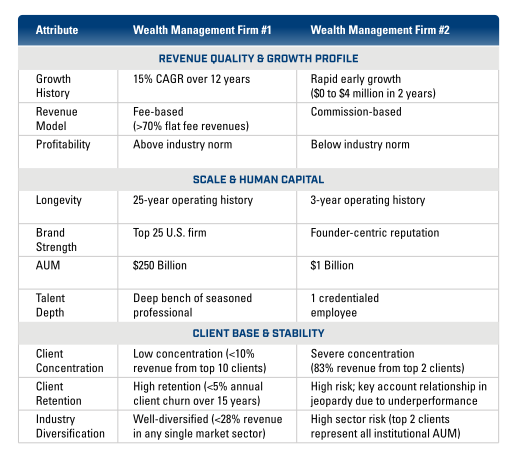
The impact of valuation drivers becomes clearer when comparing two wealth management firms with different risk profiles and operating characteristics. The table illustrates how those differences can lead to different valuation approaches, multiples, and conclusions, even within the same industry.
Wealth Management Firm 1
VRC valued Firm 1 to establish equity value for shareholder buy-in and buy-out transactions.
The primary valuation method was a five-year DCF using a relatively low discount rate, reflecting the firm’s stable operating history and lower forecasted risk. As a reasonableness check, VRC compared the value resulting from the DCF method to guideline marketplace transactions using the GTM within the market approach.
Wealth Management Firm 2
The valuation of Firm 2 established a baseline equity value for stock-based compensation and to measure future shareholder value creation.
Unlike Firm 1, a traditional DCF method was not appropriate due to the company’s elevated risk profile, client concentration, and range of potential future operating outcomes. Instead, VRC developed a probability-weighted cash flow model, with significant management input, incorporating four operating scenarios. One scenario, assigned a 25% probability weighting, assumed the company would cease operations and dissolve within three years after losing its largest client. Each scenario reflected differing assumptions regarding compensation, key value drivers, market expectations, and company-specific risk characteristics.
How Firm-Specific Risk Factors Impact Wealth Management Valuation Outcomes
Although both firms operated in the wealth management industry and provided sophisticated advisory services, their risk profiles, client concentration levels, and future outlooks differed significantly. As a result, Firm 2 generated a materially lower indicated value and implied valuation multiple than Firm 1. This example shows how company-specific factors can substantially affect valuation conclusions, even among firms in the same industry.
No single metric determines value; valuation outcomes are driven by the interaction of growth, profitability, client characteristics, management depth, service offerings, and risk. As a result, firms with similar AUM can generate significantly different valuation conclusions.
Key Takeaways on Wealth Management Firm Valuation
As consolidation continues, buyers are increasingly rewarding firms with scalable operating models, diversified client relationships, strong governance, and sustainable organic growth. Understanding these drivers well before a transaction, succession event, or shareholder transition can materially influence firm value.
For a more in-depth conversation about how VRC can develop a valuation assessment for your business, we welcome you to contact your VRC professional.