
European Private Market Update: Q4 2025
Estimated reading time: 9 minutes
The article in brief:
- European unitranche credit spreads remained broadly unchanged versus 3Q 2025, while OIDs tightened further—reflecting abundant lending capital, limited new issuance, and continued pressure on pricing for quality credits.
- Inflation continued to moderate and reference rates remained lower than recent peaks, easing interest burdens and supporting more constructive underwriting and deal dialogue heading into 2026.
- Deal pipelines improved and refinancing activity continued in 4Q 2025, with sponsors continuing to have high levels of dry powder, which should prove a tailwind for M&A activity in 2026. However, lower-quality or cyclical credits continue to face higher risk premiums amid ongoing geopolitical and policy uncertainty.
Pricing Trends
In the fourth quarter of 2025, European unitranche pricing remained broadly stable versus the third quarter, supported by strong lender demand and limited new issuance. Competitive dynamics continue to vary by segment, with the upper middle market facing greater pressure from the broadly syndicated market.
VRC’s proprietary research indicates European direct lending unitranche pricing of:
Unitranche Loan Credit Spreads, considering Coupon Spread and OID Benefit
- Traditional Middle Market (≤ ~€75mm EBITDA):
-
- Issuance Price : ~97.5 – 98.5; Coupon Margin: ~5.00% – 6.00%
- Credit Spread: ~5.25% – 6.25%
- Upper Middle Market (˃ ~€75mm EBITDA):
- Issuance Price: ~97.5 – 98.5; Coupon Margin: ~4.75% – 5.75%
- Credit Spread: ~5.00% – 6.00%
Direct lending pricing in the fourth quarter remained broadly unchanged from third quarter levels. European direct lenders continue to hold substantial dry powder, while new issuance remains limited and lender demand is high, keeping terms competitive for regular-way credits. However, more storied, lower-quality deals may carry pricing premiums, if brought to market at all, reflecting elevated uncertainty and risk that varies by industry and geography.
Direct lenders report increased pricing pressure in the upper middle market due to competition from the broadly syndicated market, while noting less competition in the lower middle market. However, debt advisors observe that certain banks are now competing aggressively in the lower middle market as well. As a result, a greater share of deals continue to price in the low to mid-range of matrix bands, though terms remain largely within those bands.
Since September, yields based on spot EURIBOR rates have remained stable, while yields based on SONIA tightened ~25bps. 5-year swap-based yields have risen ~20bps for EURIBOR-based loans and tightened ~20bps for SONIA-based loans. Looking ahead, based on the forward curves, EURIBOR is expected to increase 10bps, while SONIA is projected to decline by ~30bps over the next year. Overall, the all-in cost of debt is materially lower than in 2023 and 2024, driven by lower reference rates, tighter coupon spreads, and fees. This has contributed to lower interest burdens and, alongside heightened competition, prompted lenders to extend higher leverage levels to win deals.
Absent major shocks, purchase multiples are expected to remain elevated, credit spreads tight, and underwriting aggressive for high-quality companies. This dynamic will likely persist until new deal activity increases, helping offset the substantial dry powder held by private equity and direct lending. Cyclical and storied companies and industries will continue to require materially higher risk premiums.
Deal Volume Trends
Direct lending deal volumes increased quarter-over-quarter in the fourth quarter of 2025 to €10.0 billion from €8.1 billion (per Pitchbook’s LCD). 2025 volume surpassed 2024, reaching €41.4 billion versus €38.3 billion, as the strong first quarter of 2025 issuance more than offset weaker issuance year-over-year in quarters two through four.
While M&A volumes improved, they remain subdued due to ongoing valuation mismatches between buyers and sellers. As a result, refinancings and add-ons for existing portfolio companies continue to dominate direct lending activity. Lenders remain eager to support follow-on capital for buy-and-build strategies and other accretive investments.
In 2025, European private equity fundraising fell year-over-year to €80.8 billion from €146.7 billion due partly to the challenging exit environment for historical investments, per Pitchbook. Therefore, private equity firms are exploring alternative liquidity options—such as dividend recapitalizations, NAV financings, minority sales, and continuation funds. Direct lenders are willing to fund these strategies but approach them cautiously due to elevated risks and potential conflicts of interest.
Direct lenders report improving deal pipelines and increased due diligence activity in the fourth quarter of 2025. While it remains uncertain how many deals will close, several factors suggest positive momentum: private equity faces pressure to return capital amid extended hold periods, loan maturities are approaching, the all-in cost of debt is lower, and the macro environment has stabilized post-tariff announcements. These dynamics may support a further increase in M&A activity in 2026.
Portfolio Company Performance
Direct lenders expect portfolio performance to remain stable, supported by potential relief from high cash interest expenses. European companies may continue to benefit more than UK counterparts due to divergence in the rate-cutting cycle between the ECB and BOE, resulting in lower all-in yields for EURIBOR-based loans. While idiosyncratic issues persist, default expectations remain modest. Per Pitchbook LCD, S&P Global Ratings projected the European speculative-grade default rate to fall to 3.25% by September 2026, from 3.7% in September 2025.
While most credits are performing, some portfolio companies are showing signs of stress. Workouts primarily impact companies with known issues, especially 2021-2022 post-COVID vintages that carry higher debt loads than today’s interest rate environment supports. Sponsors and direct lenders are proactively managing these situations through common capital structure solutions, including PIK toggle adjustments, maturity extensions, sponsor equity infusions, enhanced liquidity monitoring, and covenant amendments. These measures help mitigate elevated debt costs by reducing leverage and cash interest burdens. In return, direct lenders typically receive additional economics—such as PIK premiums, amendment fees, and principal repayments—alongside enhanced control features like sale milestones, increased reporting, and tighter covenants. This constructive approach has helped limit defaults and losses across portfolios, though some cases have resulted in defaults, mostly via debt-for-equity swaps.
Conclusion
Private markets remain competitive, with high-quality companies continuing to attract strong valuations and aggressive financing terms, consistent with last quarter. Momentum appears to be building as we enter 2026. However, rising uncertainty from potential tariff impacts and geopolitical risks—particularly in Ukraine and the Middle East—is leading to less favorable terms for lower-quality credits. Compared to the U.S., Europe’s lower EURIBOR-based cost of debt may support an earlier pickup in private equity M&A activity and new loan demand. Still, Europe’s weaker growth outlook could constrain the pace and scale of recovery.
Portfolios still contain troubled companies with elevated leverage, constrained interest coverage, and near-term maturities. These situations may require restructuring or other capital structure solutions, which could weigh on valuations.
As always, valuation analyses must be approached on a case-by-case basis, emphasizing core performance metrics, debt sustainability, and liquidity. Some credits will continue to outperform others, reflecting the uneven nature of the current environment.
VRC European Market Credit Spread Matrix
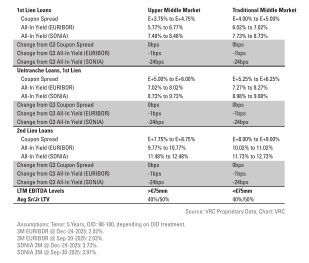 In December, VRC held credit spreads for the middle market matrix unchanged from the third quarter of 2025.
- VRC did observe tightening OIDs, with levels declining from approximately 3% to closer to 2% over the last several quarters.
- Although new deal volume improved in the second half of 2025, the availability of lending capital is still outstripping the supply of new loans for quality borrowers, thus leading to elevated competition, tight pricing, and historically aggressive capital structures based on today’s spot rates.
Quarterly GDP Growth
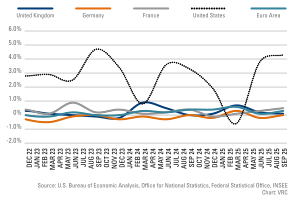 In the third quarter, U.S. GDP growth of 4.3% year-over-year remained significantly above the growth in the Euro Area and the UK. The significant rebound in growth in the U.S. was led by finance and insurance, information, and nondurable goods manufacturing segments, partially offset by the contraction of retail trade.
- Germany’s prolonged stagnation has weighed on European growth. Both France and the UK posted growth in the third quarter, with France accelerating. After a brief rebound in the first quarter of 2025, the stagnation in Germany continued in the third quarter.
- Due to Spain, Portugal, Italy and Greece, the actual Euro Area growth is better, but the key economies are lagging behind.
Inflation Rate
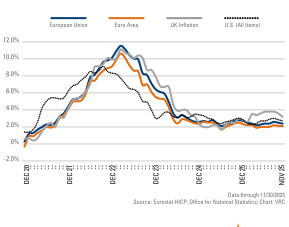 Inflation in the UK decreased to 3.2% in November, from 3.6% in October 2025, due to still high inflation in the education and housing and household services sectors (+7.6% and +5.1%, respectively).
- Inflation in the EU declined to 2.4% in November, from 2.5% in October.
- Inflation for the Euro Area remained flat from November at 2.1%.
- Inflation in Euro Area remains lower than in the US, which allowed the ECB to cut rates earlier in June 2025 to 2.00%.
- The Bank of England cut its Bank Rate by 25bps in the December 2025 meeting, bringing the rate to 3.75%. The BoE cut its Bank Rate in May and August 2025, which is still at a premium over Europe partly due to the higher overall inflation in the UK.
- In the U.S., the Federal Reserve cut rates by 25 basis points in its December 2025 meeting, bringing the Fed Funds target rate to 350-375. Market participants are currently forecasting a slower pace of rate cuts in 2026, with most expecting two to three additional 25 basis point rate cuts by December 2026, per CME FedWatch.
Reference Rates
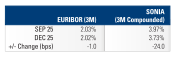
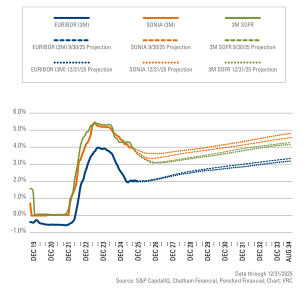 3M EURIBOR decreased to 2.02% in December, from 2.03% in September, and 3M SONIA decreased to 3.73% in December, from 3.97% in September.
- Most market participants expect central banks to lower rates in the near term, although the ECB is not expected to make any near-term movements. According to Chatham Financial forecasts, EURIBOR rates are projected to rise in early 2026, and increase to the near 2.75%-3.0% area long-term. SONIA is projected to decline to 3.75% in the near term, before increasing to the approximate 4.0-4.5% area long-term.
Secondary Spread-to-Maturity and Yield-to-Maturity
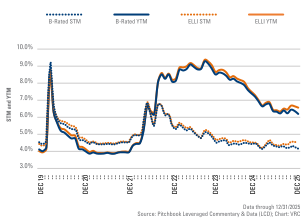 Spread to maturity for the ELLI Index increased to E+449 in December, from E+439 in September. Meanwhile, the ELLI Index YTM increased to 6.57% in December, from 6.45% in September.
- The European B-rated loan spread to maturity declined to E+415 in December, from E+418 in September. Yield to maturity for B-rated loans moved lower in December to 6.20%, from 6.23% in September.
Leveraged Loan and High-Yield Bond Volumes (€Bn)
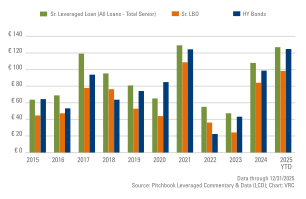 Senior loan issuance remains strong in 2025, with €127.03 billion issued in 2025, surpassing 2024’s full-year total and increased 17.7% year-over-year.
Broadly Syndicated Credit Statistics (Primary)
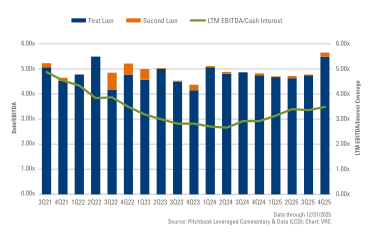 In 2025, average leverage ratios for the syndicated lending market increased above 5x for the first time since 1Q24. Meanwhile, average interest coverage was above ~3.0x for the fourth straight quarter given the decline in European reference rates. However, this remains below the near 4.0x historical average pre-2022.
Defaults
- According to S&P, European speculative-grade corporate defaults will decrease to 3.25% by September 2026 in their most recent base-case forecast. We note this is nearly 75 basis points lower than the expected default rate for the U.S.
- Overall, these levels are still relatively low compared to other higher stressed periods (great Recession, COVID, etc.) and are unlikely to lead to material portfolio losses for managers and investors.
European Private Equity Deal Activity
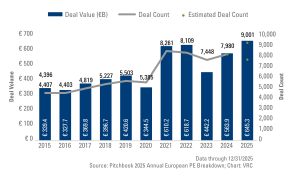 Annual 2024 European private equity deal volume of €563.9 billion represents a 27.5% increase from 2023 volumes, as reported by Pitchbook. In 2025, there has been €645.3 billion in private equity deal activity. 2025 volumes are 14.4% higher than 2024. Volumes in the fourth quarter of 2025 declined by approximately 1.4% compared to the third quarter, although in the second half of the year were 25.4% higher than the first half given the surge in activity in the latter half of the year.
- In 2025, LBO volumes increased materially, with LBO volumes accounting for 53.7% of deal volumes.
- Outlook for 2026 is more positive, with large coffers of dry powder (see below). Lower expected borrowing costs coupled with improving company valuations will likely tighten the bid-ask spread between buyers and sellers and reinvigorate M&A activity, although geopolitical uncertainty could slow how quickly activity will return.
European Private Equity Fundraising
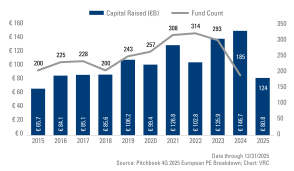 According to Pitchbook, European private equity funds raised €146.7 billion in 2024, beating 2021’s prior record of $135.9 billion. Private equity fundraising in 2025 has proven difficult, with only €80.8 billion raised during the year, a near 44.9% decline from 2024.
European Dry Powder (€M)
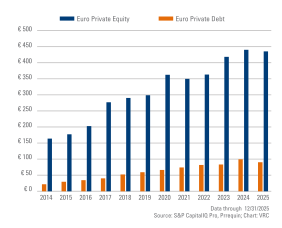 According to data from CapitalIQ Pro, cumulative dry powder in 2025 for private equity sponsors in Europe is €434.8 billion, which should fuel deal flow in for the remainder of the year without additional fundraising needs. European private debt currently has €90.6 billion of dry powder.
- These figures also support the continued high demand for private credit. Assuming an average 50% LTV on PE deals, the PE dry powder figures imply that there is an equal demand of approximately €435 billion for credit to finance private equity leveraged buyouts.
Median European EV/EBITDA Buyout Multiples
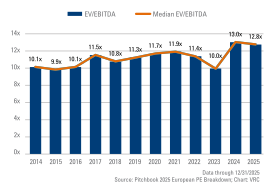 European median private equity buyout EV/EBITDA multiples rebounded by nearly 3.0x in 2024 from 10.0x in 2023 to 13.0x, according to Pitchbook. In 2025, multiples were 12.8x, just below 2024’s record high.
- Higher public market valuations and lower expected borrowing costs should bring higher deal volumes and higher valuations later in 2025.